Introduction
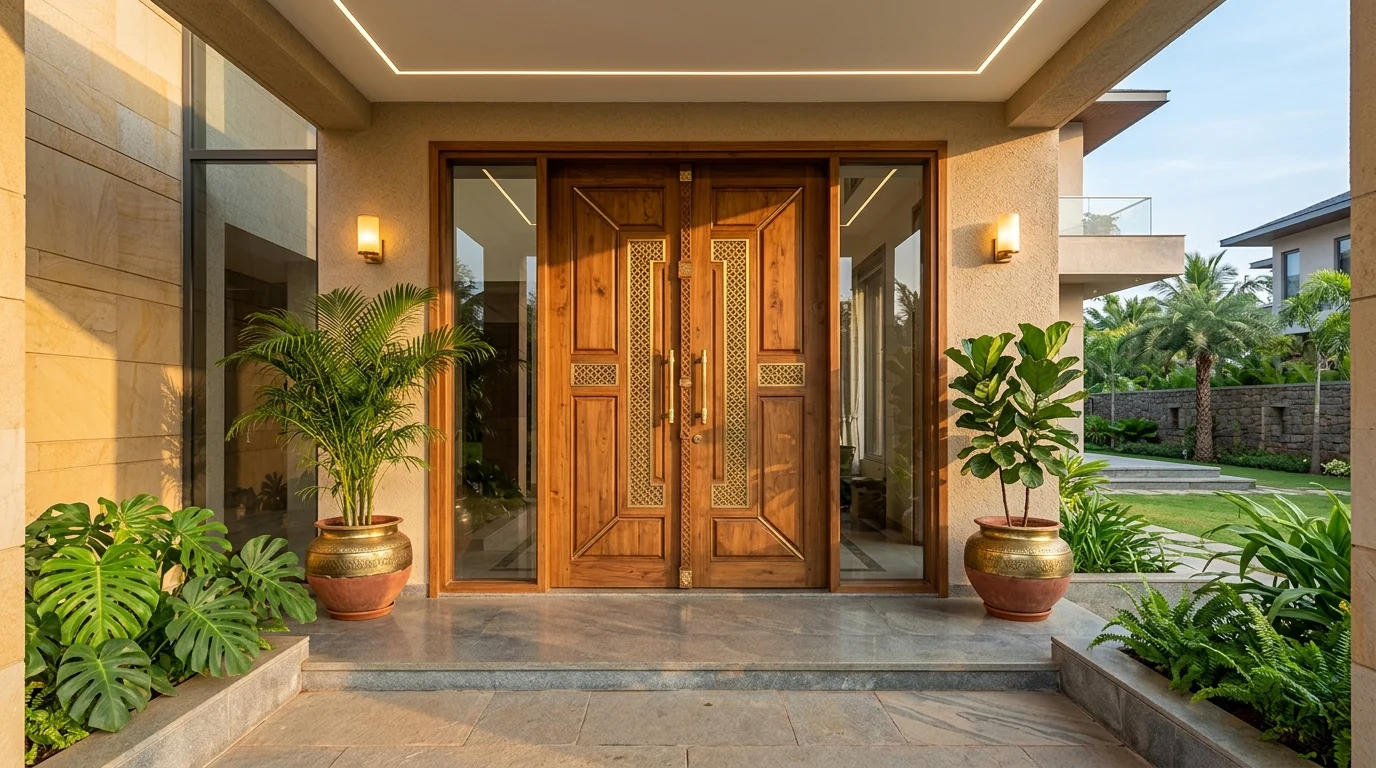
The entrance of a home is more than a physical doorway. It is the first space you see when you return home, the place where guests enter, and the transition between the outside world and your personal space. In the traditional Indian architectural system of Vastu Shastra, the main entrance is therefore given special importance.
When people search for main door house entrance vastu, they are usually looking for answers to practical questions: Which direction is best? Where should the door be positioned? Which colour should be used? Should the door open inward or outward? What can be done if the existing entrance is not considered ideal?
Vastu Shastra offers traditional guidelines for these questions. Many modern Vastu guides emphasise that direction is important, but that the exact position of the entrance, the surrounding environment, maintenance, proportions and overall layout also deserve attention.
At Astro27, you can explore astrology and Vastu-related guidance in one place and use traditional principles as a starting point for understanding your home and personal circumstances.
This guide explains main door house entrance vastu in a simple and practical way so that you can understand the major principles before making changes to your home.
Looking for Personalized Guidance?
"Your entrance sets the energetic tone for your entire household. Explore personalized Astro-Vastu consultations and floor plan analysis with Astro27."
What Is Main Door House Entrance Vastu?
Main door house entrance vastu refers to the traditional Vastu principles associated with the primary entrance of a house.
In Vastu Shastra, the main door is often treated as an important transition point because it connects the home with its external environment. Traditional Vastu practitioners consider factors such as:
- Direction of the entrance
- Exact position of the door on the wall
- Shape and proportion of the entrance
- Door material
- Door colour
- Opening direction
- Threshold
- Lighting
- Cleanliness
- Objects placed near the entrance
- Surrounding obstructions
- Relationship between the entrance and the rest of the floor plan
This means main door house entrance vastu is not simply a question of whether a house faces north, south, east or west. For a comprehensive look at property orientation, check our vastu house facing guide and our foundational tutorial on how to check vastu of house.
For example, two houses may both have east-facing entrances but have their doors positioned differently within the eastern wall. Traditional Vastu systems may evaluate those placements differently.
Therefore, if you are planning a new house, buying a property or renovating an existing entrance, consider the complete entrance rather than focusing on one factor alone.
Why Is the Main Entrance Important in Vastu?
The main entrance is traditionally considered one of the most significant parts of a home.
A doorway represents movement: people enter, leave, sunlight reaches the interior, air moves through the space, and everyday activity begins and ends around it. Vastu interprets this transition through its own traditional framework.
Modern Vastu resources frequently describe the main door as a major point through which energy enters the home.
From a practical perspective, the entrance also influences:
- First impressions
- Natural light
- Ventilation
- Security
- Accessibility
- Privacy
- Interior circulation
- Visual appearance
This is why good main door house entrance vastu should ideally work alongside practical architecture rather than replacing it.
Vastu considerations should not override structural safety, building regulations, accessibility requirements or professional architectural advice.
Which Direction Is Best for Main Door House Entrance Vastu?
One of the most common questions about main door house entrance vastu is the ideal direction.
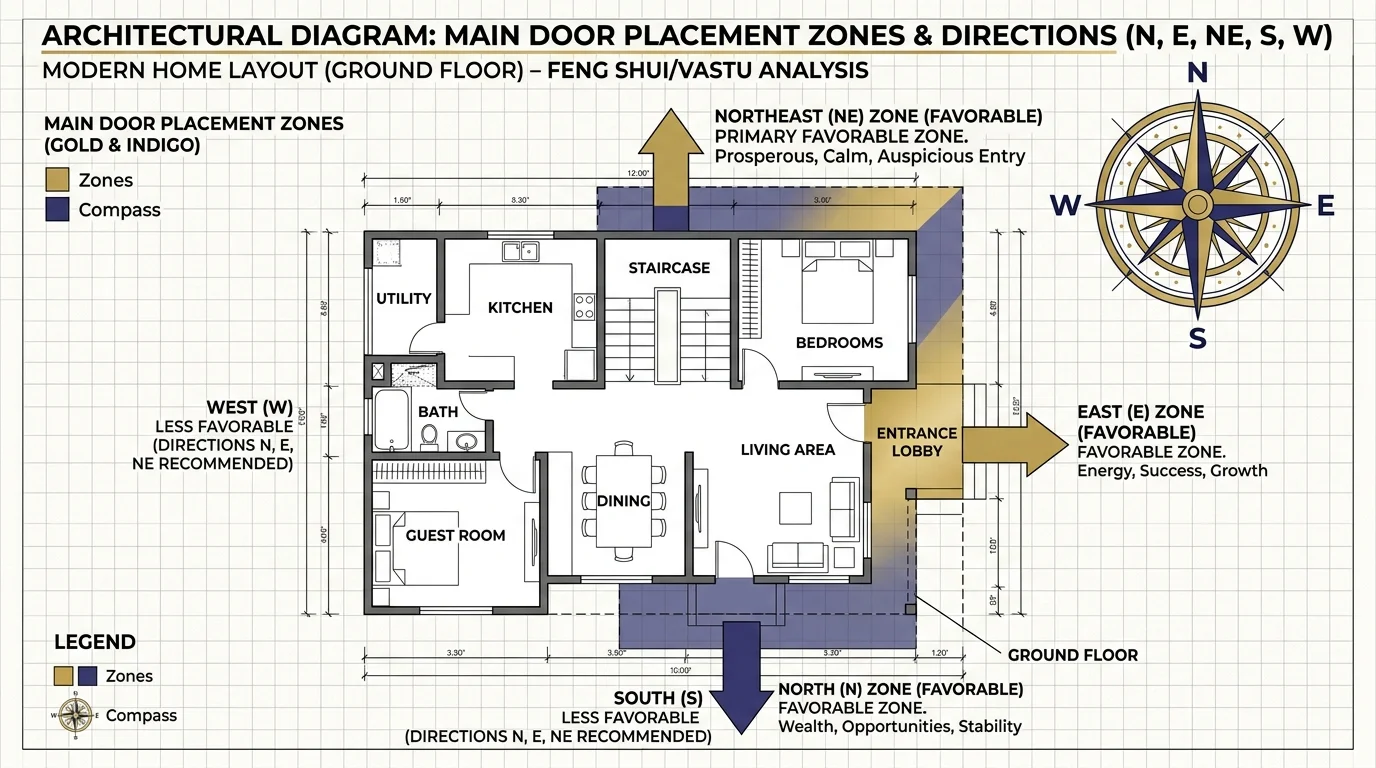
Traditional Vastu commonly gives particular importance to north, east and northeast entrances. However, the exact placement within a direction can matter, and a south- or west-facing entrance should not automatically be treated as unacceptable. Several contemporary Vastu guides specifically caution against reducing entrance Vastu to a simple "good direction versus bad direction" rule.
Let's look at the major directions.
1. North-Facing Main Door
North is traditionally associated with prosperity and opportunities.
In Vastu traditions, the north is associated with Kubera, traditionally connected with wealth. Because of this association, north-facing entrances are often considered favourable for homes.
If you are evaluating main door house entrance vastu for a north-facing property, look beyond the direction itself. The exact position of the entrance on the northern wall can also be considered.
Keep the entrance:
- Clean
- Bright
- Unobstructed
- Well maintained
- Easy to access
Avoid allowing clutter to accumulate immediately outside the entrance.
2. East-Facing Main Door
East is associated with the rising sun and is traditionally connected with vitality, new beginnings and growth.
An east-facing entrance is therefore commonly preferred in discussions about main door house entrance vastu.
Morning sunlight can also provide a practical advantage, depending on the home's orientation, surrounding buildings and local climate.
For an east-facing entrance, consider a welcoming design with sufficient natural or artificial lighting and a clear pathway.
3. Northeast Main Door
The northeast direction, often called Ishanya in Vastu terminology, receives considerable attention in traditional Vastu.
Many Vastu guides describe northeast as one of the most favourable areas for an entrance.
However, the idea that every northeast entrance is automatically perfect is an oversimplification.
The actual door position, surrounding spaces, building layout and other Vastu considerations can affect an assessment.
If you are building a new home and want a detailed main door house entrance vastu assessment, consider evaluating the complete floor plan rather than selecting a direction in isolation.
4. West-Facing Main Door
A west-facing entrance is not automatically considered negative.
Traditional Vastu systems divide each direction into different zones or padas. Consequently, the specific position of a west-facing door can be more important than simply calling the property "west-facing."
For an existing west-facing home, there is usually no reason to panic simply because the entrance is not east or north.
Instead, examine the placement and surroundings and consider appropriate traditional remedies if desired.
5. South-Facing Main Door
South-facing entrances are often misunderstood.
A popular misconception is that every south-facing entrance is automatically bad. Contemporary Vastu explanations increasingly distinguish between the direction and the exact entrance placement.
Traditional Vastu evaluates different sections of the southern side differently.
Therefore, if your house has a south-facing entrance, do not make major structural changes solely because of the direction.
A professional assessment of the actual entrance position can provide more useful information.
How to Check the Direction of Your Main Door
Correct measurement is an important part of main door house entrance vastu.
Instead of guessing the direction based on the road or the overall appearance of the building, use a reliable compass.
A commonly recommended approach is:
- Stand inside the house near its central area.
- Face the main entrance.
- Use a compass to identify the direction you are facing.
- Record the approximate degree.
- Evaluate the entrance position within that direction.
The direction a building faces and the direction of its main entrance are not necessarily identical. Contemporary Vastu guides specifically highlight this distinction.
For a new property, it can be useful to check the entrance before finalising the architectural plan. You can also explore our complete guide on how to check Vastu of house for complete directional analysis.
Main Door Placement: Why the Exact Position Matters
Direction is only one part of main door house entrance vastu.
Traditional Vastu can divide each side of a property into smaller zones or padas. To accurately verify your door's alignment, read our step-by-step guide on how to check disha of house. This means the location of the door along a wall may be considered as important as the broad compass direction.
For example, simply saying "my house faces north" may not provide enough information for a detailed Vastu assessment.
You may also need to know:
- Exact wall location
- Door width
- Door position relative to corners
- Number of entrances
- Internal layout
- Road direction
- Plot shape
- Adjacent structures
This is one reason online generalisations can sometimes be misleading.
If you want personalised guidance, Astro27 can be used to explore astrology and related traditional guidance instead of relying solely on generic social media advice.
Main Door Size According to Vastu
Traditional Vastu gives importance to proportion and symmetry.
The main entrance is generally expected to appear prominent and well proportioned compared with internal doors.
A practical approach is to ensure that your main door:
- Is large enough for comfortable movement
- Does not obstruct the entrance pathway
- Has a balanced proportion
- Is structurally secure
- Fits the architectural style of the house
The goal is not to make the entrance unnecessarily large.
A well-designed entrance should balance Vastu preferences with safety, usability and architecture.
Should the Main Door Open Inward or Outward?
Door movement is another frequently discussed aspect of main door house entrance vastu.
Many traditional Vastu recommendations favour a main door that opens inward. Some guides also associate a clockwise movement with auspicious entry.
However, practical considerations should always come first.
The door should:
- Open smoothly
- Avoid blocking corridors
- Not collide with furniture
- Provide a safe exit
- Meet applicable building and fire-safety requirements
If the existing door cannot be changed because of structural limitations, do not make unsafe modifications simply to follow a Vastu preference.
Best Material for the Main Door
Wood is one of the most commonly recommended materials in traditional discussions about main door house entrance vastu.
Wood can also provide a warm and natural appearance and works well with traditional and contemporary Indian home designs.
Common choices include:
- Teak
- Engineered wood
- Solid hardwood
- Wood and metal combinations
- High-quality composite materials
The material should ultimately be selected according to durability, climate, maintenance requirements, security and budget.
For a modern home, a wooden entrance combined with appropriate hardware can provide both visual appeal and practical functionality.
Main Door Colour as per Vastu
Colour is another popular element of main door house entrance vastu.
Traditional associations between directions and colours vary between Vastu systems, so there is no single universal colour chart that applies identically to every house.
Still, commonly discussed approaches include:
North
Green, blue and certain lighter shades are often associated with north-facing entrances.
East
Light shades, white, cream and natural wood tones are commonly considered suitable.
Northeast
White, cream and other light shades are frequently preferred.
West
Neutral, earthy and metallic-inspired tones may be considered.
South
Warmer shades are sometimes recommended depending on the specific Vastu approach and entrance zone.
Rather than repainting a door based solely on a generic internet chart, consider the exact direction and overall appearance of the entrance.
What Should You Keep Outside the Main Door?
The area immediately outside your entrance deserves attention.
A clean entrance is not only consistent with traditional main door house entrance vastu practices; it also makes the home more welcoming. For comprehensive decor ideas, toran recommendations, and mirror placement, see our companion guide on main door entrance design, colours and remedies.
Try to keep the entrance:
- Clean
- Dry
- Well lit
- Free from unnecessary objects
- Easy to walk through
- Visually organised
Avoid using the entrance area as permanent storage.
Recent Vastu coverage has highlighted clutter such as garbage, broken pots, old cartons, damaged nameplates and poor lighting as things traditionally considered undesirable around the main door.
From a practical perspective, removing clutter also improves safety and presentation.
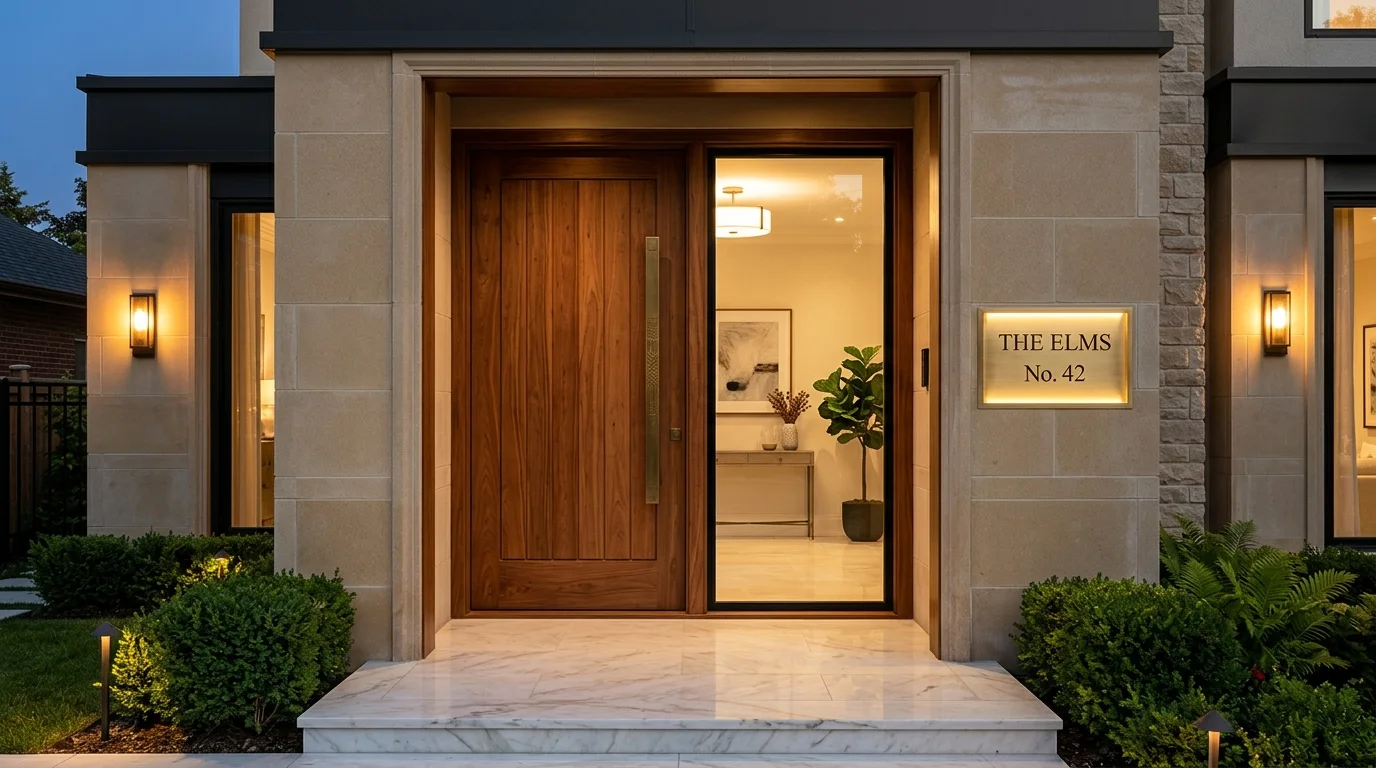
Main Door Nameplate Vastu
A nameplate is one of the simplest ways to personalise the entrance.
Traditional Vastu advice commonly favours a nameplate that is:
- Clearly visible
- Clean
- Properly mounted
- Easy to read
- Well maintained
Avoid cracked, damaged or faded nameplates.
You can select a design that matches the home's architecture instead of treating Vastu and interior design as separate concepts.
For a modern home, a simple metal, wood or acrylic nameplate can work well.
Lighting for the Main Entrance
Good lighting is an underrated part of main door house entrance vastu.
A dark entrance can feel unwelcoming and may create practical safety problems.
Consider:
- Wall-mounted lights
- Ceiling lights
- Warm ambient lighting
- Motion-sensor lights
- Pathway lighting
Make sure the lock, steps and threshold are clearly visible at night.
If your entrance receives little natural light, thoughtful artificial lighting can significantly improve the space.
What Should You Avoid at the Main Entrance?
When applying main door house entrance vastu, focus on simple improvements before expensive remedies.
Avoid:
Broken Door Hardware
A damaged handle, lock or hinge should be repaired quickly.
Excessive Clutter
Shoes, boxes and miscellaneous objects should not permanently occupy the entrance.
Poor Lighting
A dark entrance can reduce visibility and make the home feel less welcoming.
Damaged Nameplates
Replace cracked or faded nameplates.
Dead or Neglected Plants
If plants are kept near the entrance, maintain them properly.
Garbage Storage
Avoid using the main entrance as a temporary garbage-storage area.
Obstructed Pathways
The path leading to the entrance should remain clear.
These recommendations combine traditional Vastu preferences with straightforward home-maintenance principles.
What If Your Main Door Direction Is Not Considered Ideal?
This is one of the most important questions about main door house entrance vastu.
Suppose you already live in a house with a south-west entrance, or your apartment has an entrance that cannot be moved.
Should you worry?
No.
Changing the entire entrance is expensive and may be structurally impossible.
Instead, consider:
- Confirming the actual entrance direction.
- Checking the precise position of the door.
- Reviewing the complete floor plan.
- Improving cleanliness and lighting.
- Removing unnecessary obstructions.
- Maintaining the door and hardware.
- Exploring traditional Vastu remedies if you personally follow them.
- Consulting a qualified professional before making structural changes.
Vastu should be approached as a traditional guidance system rather than a reason to create unnecessary fear.
Simple Vastu Remedies for an Existing Main Door
If you cannot change the entrance, several simple traditional practices are commonly suggested.
Keep the Door Clean
Regular cleaning is one of the easiest improvements.
Improve Lighting
A well-lit entrance creates a more positive and welcoming environment.
Repair Damage
Fix broken locks, hinges, handles and door surfaces.
Use a Clean Doormat
A neat doormat helps keep the entrance organised.
Maintain Plants
If you place plants near the entrance, make sure they are healthy and cared for.
Keep the Path Clear
Avoid placing large objects directly in front of the entrance.
Maintain the Nameplate
Make sure your nameplate is readable and in good condition.
These measures do not require major construction and can be incorporated into most homes.
Main Door Vastu for Apartments
Apartment living creates a different situation.
You may not be able to control:
- Building orientation
- Main gate location
- Apartment entrance direction
- Staircase position
- Lift location
- Neighbouring doors
- Common corridors
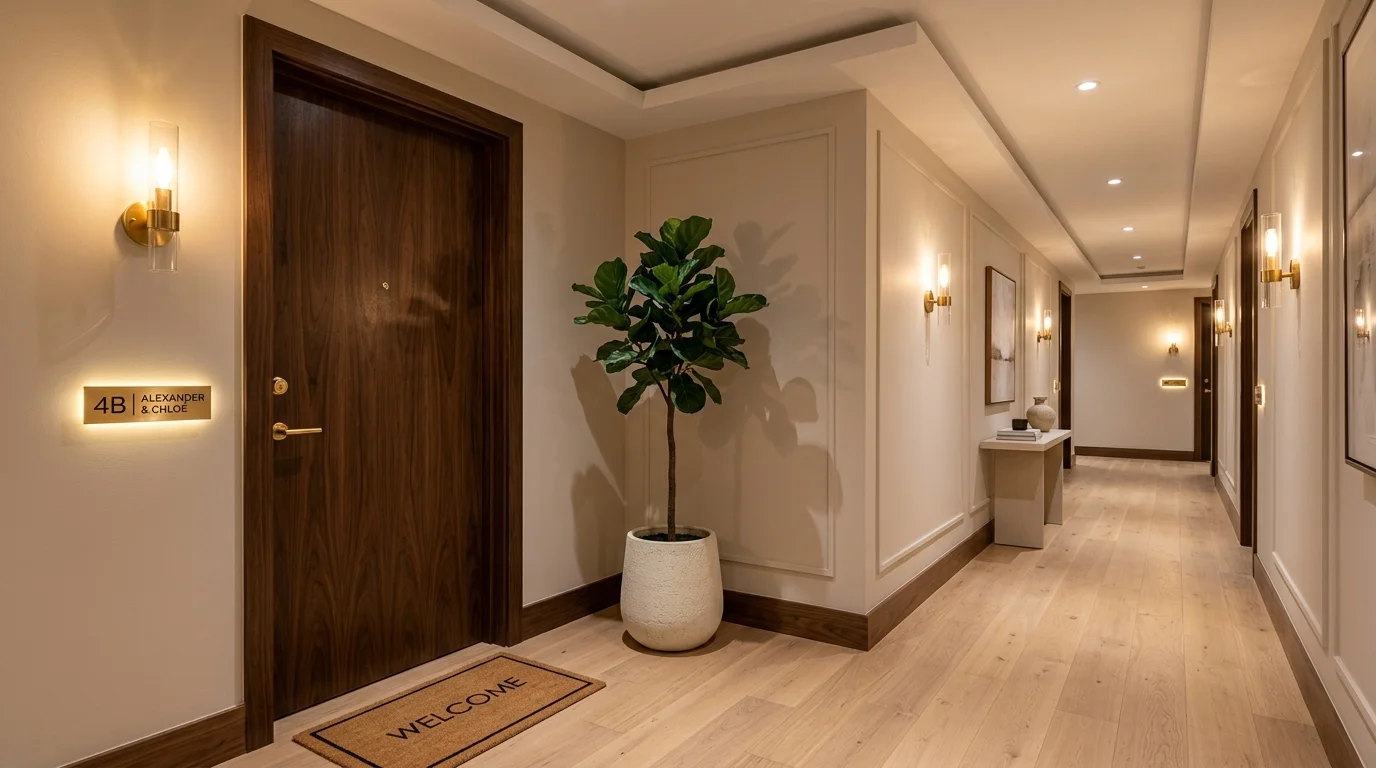
Therefore, main door house entrance vastu for an apartment should focus primarily on the actual entrance of your individual unit and the surrounding conditions.
Do not assume that the direction of the entire apartment building automatically determines the direction of your home's main door.
For renters, simple non-structural changes such as lighting, cleanliness, organisation and entrance décor are generally easier to implement.
Main Door Vastu for New Home Construction
If you are building a new home, you have more flexibility.
Before finalising the architectural design, consider evaluating:
- Plot orientation
- Road direction
- Main entrance direction
- Door placement
- Room layout
- Natural light
- Ventilation
- Staircase
- Kitchen
- Bedrooms
- Bathrooms
- Parking
- Entrance pathway
This is the stage where main door house entrance vastu can be considered alongside architecture rather than added as an afterthought.
A good process is to first create a functional architectural plan and then evaluate Vastu preferences within the practical constraints of the site.
Main Door Vastu and Modern Home Design
Vastu does not have to mean an old-fashioned entrance.
You can combine traditional preferences with contemporary design.
For example:
Traditional + Modern
Use a wooden door with minimal geometric detailing.
Luxury
Combine natural wood with premium metal hardware.
Minimalist
Choose a plain door with a clean nameplate and concealed lighting.
Indian Contemporary
Use traditional wood textures with modern lines.
Apartment Style
Use a compact entrance with a well-designed door, lighting and uncluttered surroundings.
The key is to create an entrance that feels welcoming, functional and visually balanced.
Common Mistakes People Make with Main Door Vastu
Mistake 1: Looking Only at Direction
Saying "north is good" or "south is bad" is too simplistic. The exact placement can matter.
Mistake 2: Changing the Door Without Checking the Floor Plan
The entrance is connected to the overall layout.
Mistake 3: Following Every Internet Remedy
Not every remedy applies to every house.
Mistake 4: Ignoring Practical Architecture
Safety, structural integrity and accessibility should always come first.
Mistake 5: Creating Fear
Vastu should not be used to make homeowners believe that one entrance direction guarantees failure, illness or financial loss.
Mistake 6: Ignoring Maintenance
A perfect Vastu placement cannot compensate for a broken, dirty and poorly maintained entrance.
Main Door House Entrance Vastu Checklist
Before finalising or renovating your entrance, use this quick checklist:
- Have you confirmed the actual entrance direction?
- Have you checked the exact position of the door?
- Is the entrance pathway clear?
- Is the door in good condition?
- Does the door open safely and smoothly?
- Is the entrance properly illuminated?
- Is the nameplate clean and readable?
- Is unnecessary clutter removed?
- Are plants near the entrance healthy?
- Is the entrance proportionate to the home?
- Have you considered the complete floor plan?
- Have you avoided making major structural changes based only on generic online advice?
How Astro27 Can Help You Explore Vastu Guidance
Generic articles can give you a starting point, but every home is different.
The direction of the entrance, exact door placement, floor plan, property orientation and individual circumstances can all affect how traditional Vastu principles are interpreted.
This is where Astro27 can become part of your exploration.
Instead of searching across multiple websites for disconnected astrology and Vastu information, Astro27 brings astrology-related guidance into one accessible platform.
You can use Astro27 to explore topics such as:
- Vastu guidance
- Astrology
- Birth-chart insights
- Compatibility
- Kundli-related information
- Tarot
- Personal spiritual guidance
If you are researching main door house entrance vastu because you are building a home, purchasing property or redesigning your entrance, use general Vastu principles as your starting point and then seek personalised guidance where appropriate.
Explore Astro27 to discover more astrology and Vastu-related guidance for your personal questions.
Final Thoughts
The main entrance is an important part of every home, both practically and symbolically.
Traditional main door house entrance vastu focuses on direction, placement, proportions, materials, colours and the environment surrounding the entrance. North, east and northeast are frequently highlighted as favourable directions, but the exact placement of the entrance can be just as important as the broad direction.
At the same time, Vastu should not become a source of unnecessary anxiety.
If your existing entrance does not match a popular online recommendation, there is no reason to assume that your home is automatically unlucky. Start with practical improvements: keep the entrance clean, maintain the door, improve lighting, remove clutter and ensure that the pathway is safe.
For new construction, Vastu can be considered alongside professional architectural planning. For an existing home, simple non-structural improvements may be enough if you choose to follow traditional Vastu practices.
Most importantly, remember that no single entrance direction can guarantee wealth, health, relationships or success. Vastu is a traditional belief and architectural philosophy, not a substitute for financial planning, medical care, structural engineering or practical decision-making.
If you are curious about how traditional astrology and Vastu concepts may relate to your own circumstances, Astro27 provides a convenient place to explore these subjects further.
Your entrance is the beginning of your home. Make it welcoming, functional, balanced and meaningful.
Get Expert Main Door Vastu Consultation
Have questions about your home's main entrance or floor plan orientation? Consult with experienced Vedic & Vastu advisors on Astro27.
Consult with Astro27