
Knowing the correct direction of your home is one of the first steps in understanding its Vastu layout. Many homeowners know that directions such as North, East, South and West are important, but they are often unsure how to identify them accurately.
If you have ever wondered how to check disha of house, you can actually do it yourself with a simple compass or smartphone. However, getting the correct reading is important because even a small measurement mistake can lead to an incorrect understanding of the home's orientation.
In Vastu Shastra, direction is not simply about whether a property faces a particular road. The direction in which you face when standing at the main entrance and looking outward is commonly used to identify the home's facing direction. A compass can then help you confirm the exact bearing.
This guide explains how to check disha of house step by step, how to use your mobile phone, how to identify North, South, East and West, what the eight Vastu directions mean, common mistakes to avoid, and how you can take the next step with Astro27 for personalised astrology and Vastu guidance.
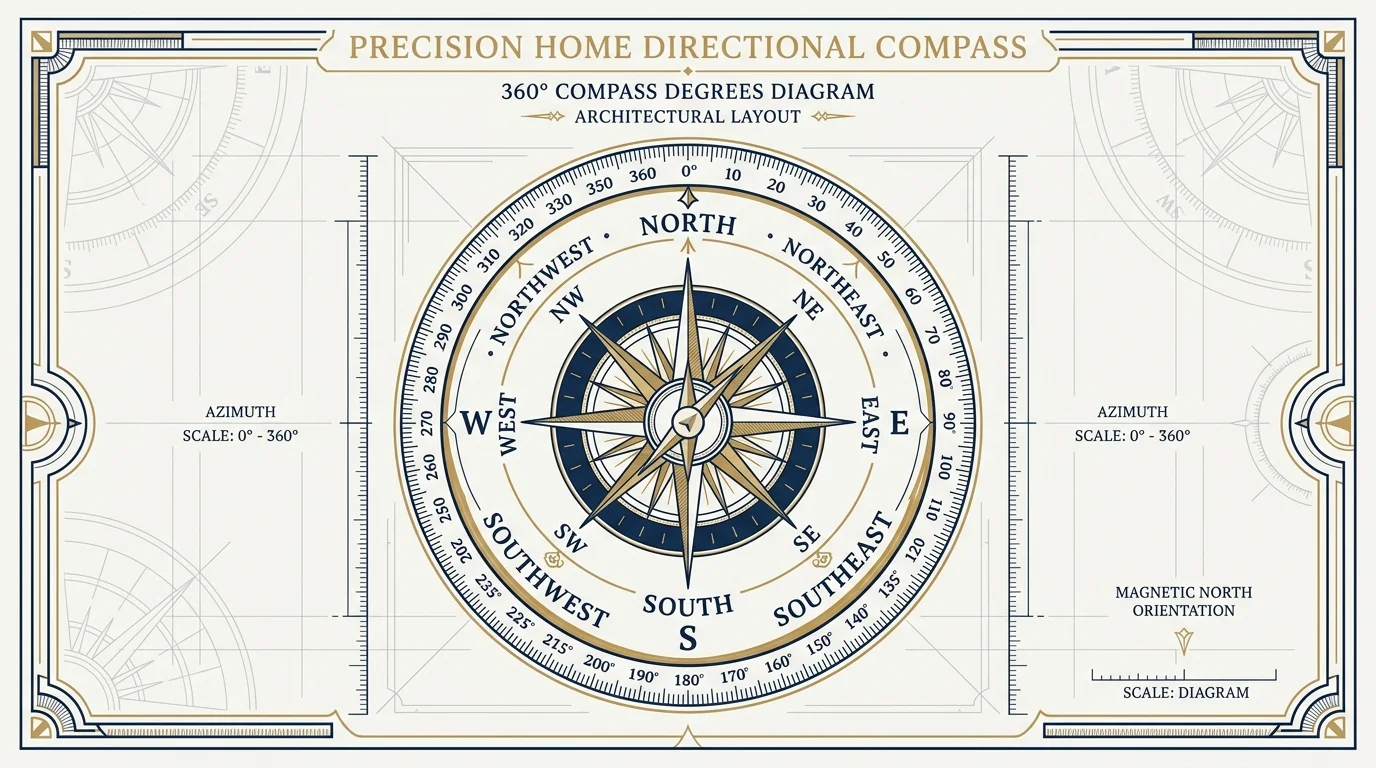
Quick answer: To understand how to check disha of house, stand at the centre of your main entrance, face outward as if you are leaving the property, and use a reliable compass. The direction you are facing is generally considered the house-facing direction. For example, 0° or 360° indicates North, 90° indicates East, 180° indicates South and 270° indicates West.
What Does Disha Mean in Vastu?
Before learning how to check disha of house, it is useful to understand what "disha" means.
The word disha refers to direction. In everyday life, directions help us navigate from one location to another. In Vastu Shastra, directions are traditionally used to organise different areas of a building and understand their relationship with the Vastu Purusha Mandala.
The four primary directions are:
- North
- South
- East
- West
These are further divided into four intercardinal directions:
- North-East (Ishanya)
- South-East (Agni)
- South-West (Nairuthi)
- North-West (Vayu)
Together, these create the eight commonly discussed Vastu directions.
When people search for how to check disha of house, they are usually trying to determine which direction their main entrance faces. This is different from simply asking which side of the property touches the road.
For example, a house may be located on an east-west road, but its main entrance could face North. Therefore, looking only at the road can give you the wrong answer.
Why Is It Important to Know Your House Direction?
One reason people research how to check disha of house is because direction is an important starting point for a Vastu assessment.
Traditional Vastu principles associate different zones of a property with different elements and functions. Once you know the orientation of your home, you can map these zones more accurately.
For example, a Vastu assessment may consider:
- The location of the main entrance
- Kitchen placement
- Bedroom placement
- Prayer or meditation area
- Living room
- Toilets and bathrooms
- Staircases
- Windows and ventilation
- Open spaces
- Storage areas
- Centre of the property (Brahmasthan)
However, it is important not to assume that one direction automatically makes a house "good" or "bad." A property's overall layout matters.
This is why understanding how to check disha of house should be treated as the first step rather than the complete Vastu analysis. You can also review our detailed guide on how to check Vastu of house for full room-by-room assessments.
A north-facing home, for example, can have a very different layout from another north-facing home. The location of the entrance within the north side, the internal room arrangement and the proportions of the property can all change the assessment.
How to Check Disha of House Using a Compass
The simplest way to learn how to check disha of house is to use a magnetic compass.
You can use either:
- A traditional physical compass
- A smartphone compass application
The basic process is straightforward.
Step 1: Go to the Main Entrance
Stand at your home's main entrance. Ideally, position yourself around the centre of the doorway rather than standing far to one side.
Step 2: Face Outside
Now face outward, as though you are walking out of your home. This point is important because many people make the mistake of facing toward the interior of the house. The direction you face while looking outward from the main entrance is generally used to determine the house-facing direction in common Vastu practice.
Step 3: Hold the Compass Correctly
Hold the compass flat and allow the needle to settle. If you are using a smartphone, keep the phone reasonably level and away from objects that may interfere with its magnetic sensor.
Step 4: Record the Degree
Look at the numerical bearing shown by the compass.
A basic reference is:
| Compass Reading | Direction |
|---|---|
| 0° / 360° | North |
| 45° | North-East |
| 90° | East |
| 135° | South-East |
| 180° | South |
| 225° | South-West |
| 270° | West |
| 315° | North-West |
This is one of the most useful things to remember when learning how to check disha of house.
Step 5: Take Multiple Readings
Do not rely on a single measurement if you are unsure. Take several readings while maintaining approximately the same position. If the results are significantly different, investigate possible magnetic interference before deciding on the final direction.
How to Check Disha of House With Mobile
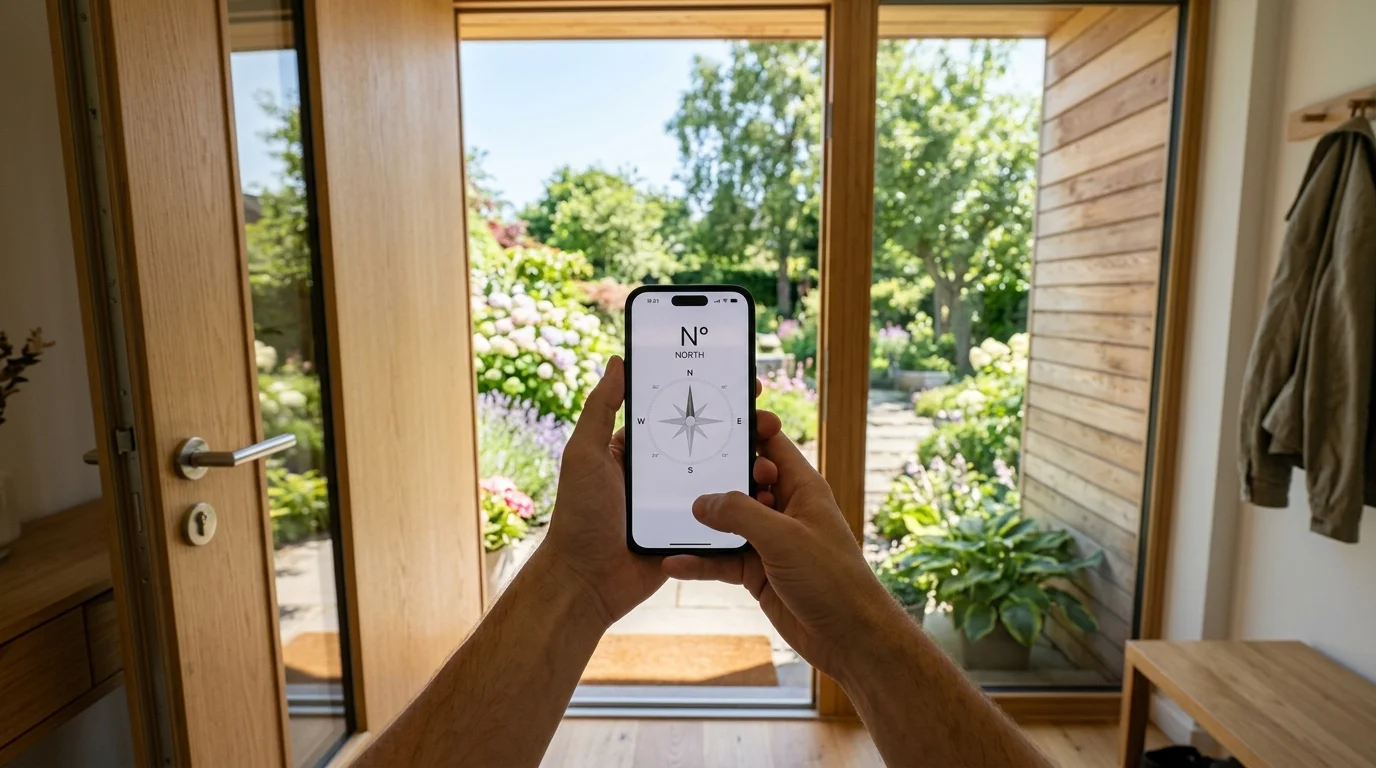
Today, you do not necessarily need a separate compass to understand how to check disha of house.
Most smartphones contain a magnetic sensor that can work with a compass application.
The process is simple.
1. Open a Compass App
Open the compass application available on your smartphone. If your phone does not have one, you can use a reputable compass application.
2. Calibrate the Phone
If the application asks you to calibrate the device, follow its instructions. Some compass applications use movement patterns to calibrate the magnetic sensor.
3. Go to the Main Door
Stand near the centre of the main entrance.
4. Face Outward
Face away from the home. Do not turn the phone randomly while trying to read the direction.
5. Keep the Phone Stable
Hold it steadily and wait for the reading to settle.
6. Note the Degree
Record the number shown by the compass.
For example:
- 4°: approximately North
- 48°: approximately North-East
- 92°: approximately East
- 140°: approximately South-East
- 178°: approximately South
- 230°: approximately South-West
- 268°: approximately West
- 320°: approximately North-West
This makes how to check disha of house much easier for someone who does not own a traditional compass.
How to Check Disha of House Without Making Common Compass Mistakes
Learning how to check disha of house is easy. Getting a reliable reading requires a little more care.
Smartphone compasses can be affected by nearby magnetic materials and electronic equipment.
Try to avoid taking measurements directly beside:
- Metal gates
- Steel doors
- Refrigerators
- Electrical panels
- Large speakers
- Vehicles
- Metal railings
- Heavy machinery
- Large electronic devices
Some current Vastu guides specifically recommend moving away from metal and electronic interference when taking a compass reading.
If the reading keeps jumping, move to another nearby position and repeat the measurement.
Take Three Readings
One practical approach is to take three readings:
Reading 1: At the main entrance
Reading 2: A short distance away from obvious metal interference
Reading 3: Another nearby position with the phone held steadily
If the readings are broadly consistent, you have a much better basis for identifying the direction.
How to Check Disha of House: Understanding Compass Degrees
If you want a more precise answer to how to check disha of house, learning compass degrees is helpful.
The compass contains 360 degrees.
- North is positioned at 0° or 360°.
- East is 90°.
- South is 180°.
- West is 270°.
The remaining degrees fall between these major directions.
A commonly used eight-direction breakdown is approximately:
- North: 337.5°–22.5°
- North-East: 22.5°–67.5°
- East: 67.5°–112.5°
- South-East: 112.5°–157.5°
- South: 157.5°–202.5°
- South-West: 202.5°–247.5°
- West: 247.5°–292.5°
- North-West: 292.5°–337.5°
These ranges are useful when your house does not face exactly 0°, 90°, 180° or 270°.
For instance, if your compass shows 84°, your house can generally be described as East-facing.
If it shows 42°, it falls within the North-East range.
If it shows 215°, it falls within the South-West range.
This is why recording the actual degree is better than simply guessing the direction.
House Direction vs Main Door Direction: Are They the Same?
This is one of the most common questions related to how to check disha of house.
In everyday conversations, people often use "house direction" and "main door direction" interchangeably.
However, a detailed Vastu assessment can involve more precise measurements.
For a basic house-facing assessment, the direction you face while standing at the main entrance and looking outward is commonly used.
But a deeper Vastu analysis can examine the relationship between:
- The centre of the property (Brahmasthan)
- The building's orientation
- The entrance location
- The floor plan
- Directional zones
- Entrance subdivisions or padas
Therefore, knowing the entrance direction does not automatically provide a complete Vastu diagnosis.
This distinction is particularly important if you are trying how to check disha of house because you want to make decisions about buying, constructing or renovating a property.
What Are the Eight Directions in Vastu?
Once you understand how to check disha of house, the next step is learning the eight main directions.
1. North
North is traditionally associated with prosperity, movement and certain forms of financial opportunity in Vastu traditions. It is often discussed in relation to Kubera, traditionally regarded as the deity associated with wealth. However, the direction alone should not be used to judge an entire property.
2. North-East
North-East is commonly known as Ishanya. It is traditionally considered an important and sensitive zone in Vastu. It is often associated with spirituality, clarity, water and openness. Many Vastu recommendations encourage keeping this zone relatively light and uncluttered.
3. East
East is associated with the rising sun and is traditionally linked with light, vitality and beginnings. East-facing entrances are frequently discussed in residential Vastu.
4. South-East
South-East is commonly associated with the fire element and is traditionally connected with Agni. It is frequently considered when discussing kitchen placement.
5. South
South is often associated with strength, stability and transformation in traditional Vastu interpretations. A south-facing home should not automatically be labelled unsuitable. The entrance location and overall floor plan need to be assessed.
6. South-West
South-West is traditionally connected with stability and grounding. It is commonly discussed in relation to heavier spaces and master bedrooms.
7. West
West is associated with the setting sun and is frequently discussed in relation to stability and gains. A west-facing house can still be a practical and comfortable home when its architecture and internal layout are properly designed.
8. North-West
North-West is commonly associated with movement, air and change. It is often considered for guest rooms and certain transitional functions.
These interpretations form part of traditional Vastu practice and should not be treated as scientific guarantees.
Is North the Best Direction for a House?
After searching how to check disha of house, many homeowners immediately ask another question: "Which direction is best?"
There is no single answer that should apply to every property.
Traditional Vastu sources often favour North, East and North-East for certain residential applications, but a property's complete layout matters.
For example, two North-facing houses may have:
- Different entrance positions
- Different room layouts
- Different plot shapes
- Different surrounding structures
- Different ventilation
- Different natural light
- Different staircase locations
Therefore, simply identifying North does not complete the analysis.
The better approach is:
Direction → Entrance → Floor plan → Room placement → Vastu assessment → Personal considerations
This is also why knowing how to check disha of house is only the beginning of a proper assessment.
Is a South-Facing House Bad?
One of the biggest misconceptions around how to check disha of house is that a South-facing home is automatically negative.
That is an oversimplification.
A home's direction should not be judged independently of its design.
A South-facing property can have different entrance placements, room configurations and environmental conditions. Sun exposure, ventilation, shading and the actual position of the entrance can also affect the home's practical comfort.
Even sources discussing Vastu generally caution against treating house direction as an automatic good-or-bad classification.
If you have a South-facing home, do not panic or make expensive structural changes simply because of the direction. First understand the actual layout. Then consider whether a professional assessment is appropriate.
How to Check Disha of House From a Floor Plan
Sometimes you may not be physically present at the property. In that case, learning how to check disha of house from a floor plan can be useful.
If you have an architectural drawing, look for a North arrow.
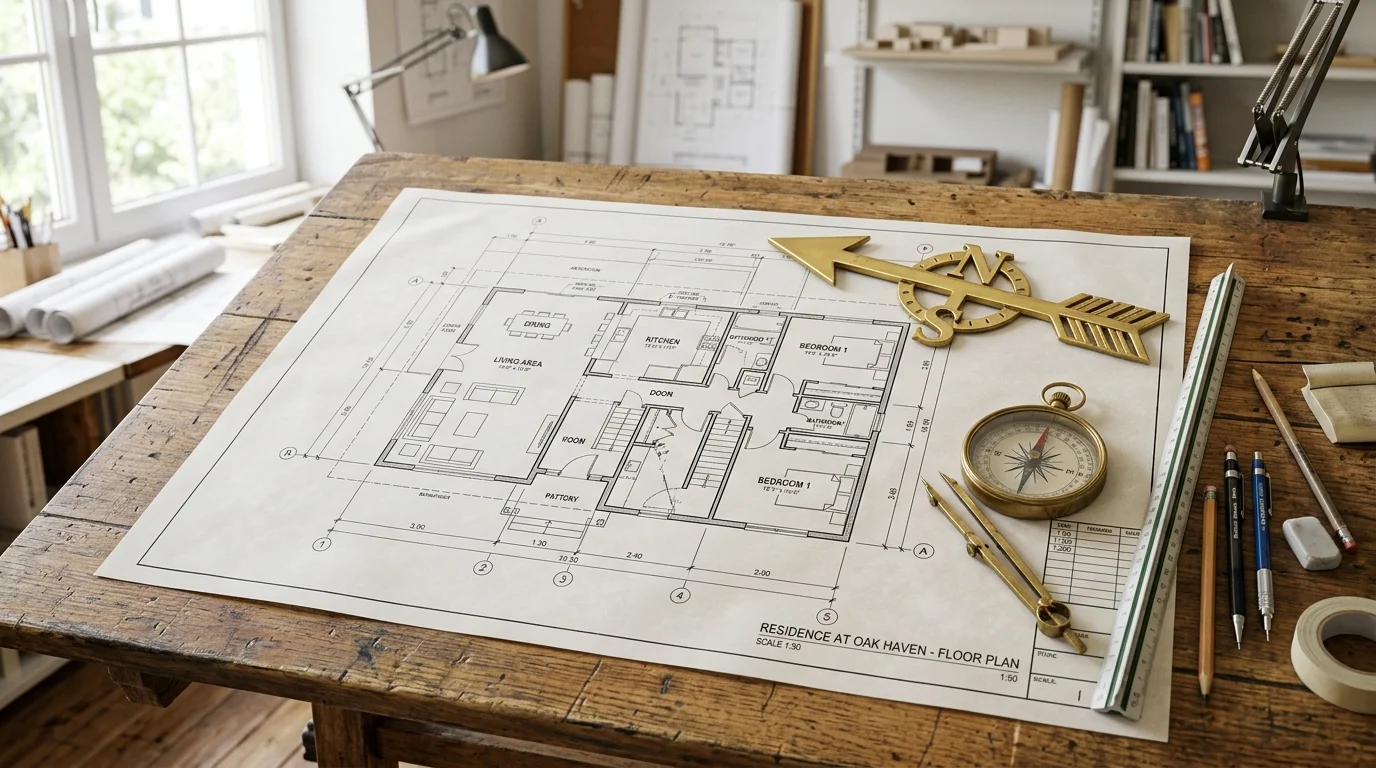
Most professional floor plans contain a directional indicator. Once North is identified, you can determine:
- East
- West
- South
- North-East
- South-East
- South-West
- North-West
However, be careful when using screenshots, rotated floor plans or property brochures.
A floor plan may have been rotated for presentation. For example, the top of an image does not necessarily mean North. Always look for an actual North arrow or verified orientation.
If there is no directional marker, a compass measurement at the property is preferable.
How to Check Disha of House When the Main Door Is Not the Obvious Entrance
Some properties have multiple entrances, separate gates, apartment corridors, service entrances, balcony doors, garage entrances, or secondary doors.
This can make how to check disha of house confusing.
For a basic assessment, identify the primary entrance used as the main access point to the home. Do not automatically use the direction of the balcony, parking gate or secondary service door.
For apartments, the entrance to the individual flat is generally more relevant to the flat's facing assessment than the direction of the building's parking gate.
For a detailed Vastu analysis, however, the property type and floor plan should be considered together.
Five Mistakes People Make While Checking House Direction
Understanding how to check disha of house also means knowing what not to do.
Mistake 1: Looking at the Road Instead of the Entrance
A property facing an east-west road does not necessarily have an East-facing entrance. Always verify the actual entrance orientation.
Mistake 2: Facing Inside the House
If you stand at the door facing into the house, your compass reading is opposite to the outward-facing direction. For a basic facing assessment, stand at the entrance and look outward.
Mistake 3: Trusting a Random Phone Reading
If the compass is affected by nearby metal, the reading can become unreliable. Move away from interference and repeat the measurement.
Mistake 4: Assuming the Top of a Floor Plan Is North
Architectural drawings can be rotated. Look for the North indicator.
Mistake 5: Judging the Entire House From One Direction
This is perhaps the biggest mistake. Knowing how to check disha of house does not mean you know whether the entire property is Vastu-compliant. Direction is only one part of the assessment.
How to Check Disha of House Before Buying a Property
If you are purchasing a new home, learning how to check disha of house before signing the deal can be useful if Vastu is important to you.
Before buying, consider checking:
- Main entrance direction: Record the actual compass reading.
- Plot orientation: Understand the overall shape and orientation of the property.
- Floor plan: Check where the kitchen, bedrooms, toilets, staircase and living spaces are located.
- Natural light: Observe how sunlight enters the property.
- Ventilation: Check airflow between rooms and external openings.
- Surrounding structures: Look at neighbouring buildings, roads and major obstructions.
- Practical usability: Do not choose a home based only on a direction label. A property should also meet your needs for comfort, safety, accessibility and budget.
How Astro27 Can Help After You Check Your House Direction
Once you understand how to check disha of house, you may be able to identify the broad direction yourself.
But the next question is: What should you do with that information?
This is where a personalised astrology and Vastu consultation can become useful.
Astro27 can be positioned as the next step for people who want to move beyond generic online Vastu tips and understand their individual situation.
For example, instead of simply asking "Is my house East-facing?", you can ask broader questions such as:
- Is the entrance suitable for my property?
- How should I interpret my floor plan?
- Which areas of the home require attention?
- What should I check before buying a property?
- Are there practical Vastu considerations for my existing home?
- Should I make changes, or is the current layout workable?
The purpose of checking how to check disha of house is therefore not simply to collect a compass reading. It is to gather accurate information that can be used for a more informed assessment.
Astro27 can help turn that initial information into a more personalised conversation around astrology, Vastu and your property.
Why Personalised Vastu Can Be More Useful Than Generic Tips
Search results for how to check disha of house often provide general rules like "North is good," "South is bad," or "Put that object there."
The problem is that homes and people are not identical.
A family may have a completely different floor plan from another family. A rented apartment cannot always be structurally modified. A person buying a property may have a different priority from someone already living in the same house.
Therefore, generic information can be useful for education, but it should not automatically become a reason to spend money on renovations or remedies.
A more thoughtful process is: Measure first. Understand second. Assess third. Act last.
Simple House Direction Checklist
If you want a quick reference for how to check disha of house, save this checklist.
Before Measuring
- Find the main entrance.
- Identify the centre of the entrance.
- Keep your smartphone or compass ready.
- Move away from obvious metal interference.
- Make sure the compass is calibrated.
During Measurement
- Stand at the entrance.
- Face outward.
- Keep the compass level.
- Wait for the reading to settle.
- Record the degree.
After Measurement
- Compare the degree with the eight-direction ranges.
- Take another reading to verify.
- Check the floor plan's North indicator if available.
- Do not confuse road direction with house-facing direction.
- Do not judge the entire property from direction alone.
For a Deeper Assessment
- Review the complete floor plan.
- Identify the main entrance location.
- Map the major rooms.
- Consider the centre of the property.
- Consult a qualified professional if you need personalised guidance.
Quick Reference: House Direction by Compass
| Degree | House Direction |
|---|---|
| 0° / 360° | North |
| 45° | North-East |
| 90° | East |
| 135° | South-East |
| 180° | South |
| 225° | South-West |
| 270° | West |
| 315° | North-West |
Final Thoughts: Start With Direction, Then Go Deeper
If you have been searching for how to check disha of house, the good news is that the first step is simple.
Go to your main entrance. Stand near its centre. Face outward. Use a compass. Record the degree. Then identify whether the property is North, North-East, East, South-East, South, South-West, West or North-West facing.
But do not stop there. The compass tells you the direction. It does not tell you the entire story of your home.
A meaningful Vastu assessment requires looking at the property as a complete system. The entrance, floor plan, room placement, open areas and other characteristics all contribute to the assessment.
And if you are trying how to check disha of house because you are planning to buy a property, construct a home, redesign your current space or understand an existing Vastu concern, this is where personalised guidance can be more useful than copying generic internet remedies.
Astro27 can be your next step after finding your house direction. Instead of stopping at a simple North-versus-South answer, explore your property and personal requirements more carefully through astrology and Vastu guidance.
Need Expert Direction & Floor Plan Analysis?
Unsure about your compass readings or complex room orientations? Consult verified Astro-Vastu experts on Astro27 for tailored property guidance.
Consult with Astro27