Marriage is one of the most important decisions in life, and in Vedic astrology, kundli matching is traditionally used to understand the compatibility between two people before marriage. By comparing the birth charts of the prospective bride and groom, astrologers examine factors related to personality, emotional compatibility, family life, health, finances, intimacy, and long-term marital harmony.
Unlike simply comparing Sun signs, kundli matching considers the Moon sign, Nakshatra, planetary positions, houses, and specific doshas. The traditional process is primarily based on Ashtakoota Guna Milan, in which 36 points are evaluated across eight categories.
A good kundli matching result is not determined only by the total number of points. A deeper analysis considers which Kootas match, whether important doshas are present, the strength of the seventh house, Venus and Jupiter, and whether there are cancellation or mitigating factors.
This comprehensive guide explains kundli matching, different Rashi combinations, the meaning of Rajyotak, important doshas, and how compatibility can be interpreted more responsibly.
What Is Kundli Matching?
kundli matching is the traditional Vedic astrology practice of comparing two birth charts to evaluate marriage compatibility. The charts are prepared using the exact date, time, and place of birth of both individuals.
The Moon plays an especially important role because the Moon sign and Nakshatra are used extensively in the traditional Guna Milan system.
During kundli matching, astrologers generally examine:
- Moon sign (Rashi) and Lagna compatibility
- Nakshatra compatibility
- Ashtakoota Guna Milan
- Gana compatibility
- Yoni compatibility
- Graha Maitri
- Bhakoot
- Nadi
- Manglik or Mangal Dosha
- Seventh house and its lord
- Venus and Jupiter
- Planetary aspects
- Dasha periods
- Dosha cancellation or mitigation
Therefore, kundli matching is more comprehensive than simply checking whether two zodiac signs are compatible.
Why Is Kundli Matching Important for Marriage?
The traditional purpose of kundli matching is to identify areas where two individuals may naturally support each other and areas where additional challenges could arise.
Astrologers may use the birth charts to assess:
Emotional Compatibility
The Moon represents the mind, emotions, habits, and psychological tendencies in Vedic astrology. Strong Moon-based compatibility may indicate similar emotional rhythms and easier mutual understanding.
Communication and Personality
The influence of the Moon, Mercury, Ascendant, and relevant houses can provide insights into communication styles and temperament.
Family and Domestic Life
The fourth house, Moon, second house, and other relevant planetary combinations may be considered when evaluating family dynamics and domestic stability.
Marriage and Partnership
The seventh house is traditionally associated with marriage and partnerships. Its lord, occupants, aspects, and overall strength can be examined alongside Venus and Jupiter.
Long-Term Compatibility
kundli matching can also involve examining planetary periods and the overall strength of both charts rather than relying exclusively on the Guna score.
Ashtakoota Kundli Matching: The 36 Guna System
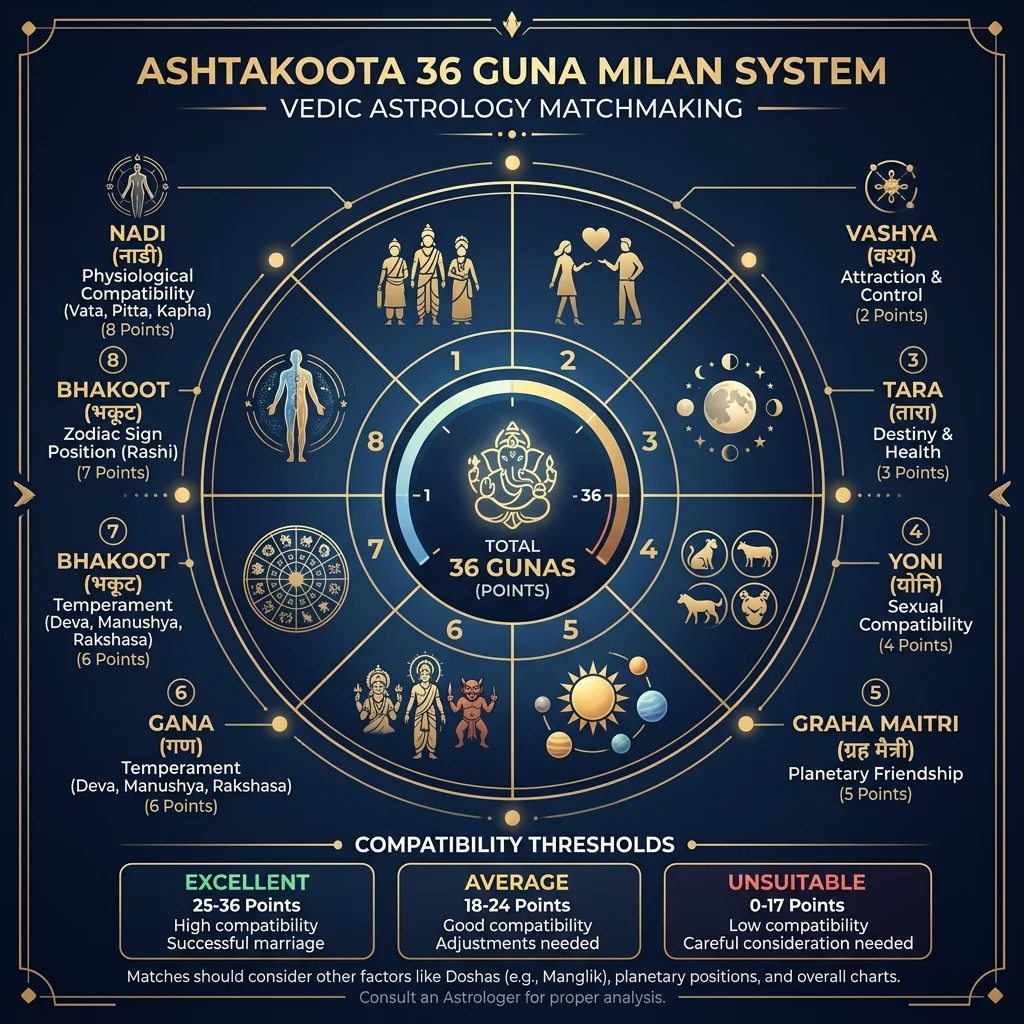
The most commonly known form of kundli matching is Ashtakoota Guna Milan. It assigns a maximum of 36 points across eight different Kootas.
| Koota | Maximum Points | Main Area |
|---|---:|---|
| Varna | 1 | Values and spiritual compatibility |
| Vashya | 2 | Mutual influence and attraction |
| Tara | 3 | Birth-star compatibility |
| Yoni | 4 | Physical and instinctive compatibility |
| Graha Maitri | 5 | Mental and intellectual compatibility |
| Gana | 6 | Temperament |
| Bhakoot | 7 | Emotional and family compatibility |
| Nadi | 8 | Health and biological compatibility |
| Total | 36 | Overall Guna Milan |
Traditionally, a score below 18 is often considered insufficient, while 18 or more is generally regarded as an acceptable starting point. However, a high score does not automatically guarantee a successful marriage.
This is one of the most important principles of kundli matching: the quality and context of the individual Kootas matter, not just the final number.
Understanding Different Rashis in Kundli Matching
Rashi compatibility is a major part of kundli matching. The 12 Rashis are divided into different elemental and behavioral categories.
The twelve Rashis are:
- Aries — Mesha
- Taurus — Vrishabha
- Gemini — Mithuna
- Cancer — Karka
- Leo — Simha
- Virgo — Kanya
- Libra — Tula
- Scorpio — Vrishchika
- Sagittarius — Dhanu
- Capricorn — Makara
- Aquarius — Kumbha
- Pisces — Meena
However, kundli matching should not treat Rashi combinations as rigid rules. Two people with traditionally challenging Rashi combinations may still have supportive planetary placements elsewhere in their charts.
Fire Rashis: Aries, Leo and Sagittarius
Fire Rashis are traditionally associated with enthusiasm, independence, confidence, ambition, and action.
Aries
Aries individuals may be direct, energetic, competitive, and independent. In kundli matching, Aries can traditionally have good compatibility with other energetic signs, but excessive assertiveness may create conflict if both partners have strong Mars influence.
Leo
Leo is associated with confidence, leadership, loyalty, and self-expression. Leo can benefit from a partner who appreciates its need for recognition while maintaining emotional balance.
Sagittarius
Sagittarius is associated with optimism, exploration, knowledge, and independence. It may traditionally harmonize well with partners who respect personal freedom and intellectual growth.
Earth Rashis: Taurus, Virgo and Capricorn
Earth Rashis are generally associated with practicality, stability, responsibility, and material security.
Taurus
Taurus may value loyalty, consistency, comfort, and financial stability. In kundli matching, Taurus can traditionally have strong compatibility with stable Earth and emotionally supportive Water influences.
Virgo
Virgo is associated with analysis, organization, practicality, and attention to detail. Its analytical nature can be beneficial in marriage but may sometimes appear overly critical.
Capricorn
Capricorn is traditionally associated with discipline, ambition, responsibility, and long-term planning. Capricorn compatibility may improve when both partners understand each other's expectations regarding career and family responsibilities.
Air Rashis: Gemini, Libra and Aquarius
Air Rashis are traditionally associated with communication, ideas, social interaction, and intellectual curiosity.
Gemini
Gemini is adaptable, communicative, curious, and mentally active. Good kundli matching for Gemini generally requires a partner who appreciates communication and variety.
Libra
Libra is associated with partnership, balance, diplomacy, and harmony. Libra often values cooperation and may seek an aesthetically and emotionally balanced relationship.
Aquarius
Aquarius is traditionally associated with independence, originality, social ideals, and unconventional thinking. It may require a partner who respects individuality.
Water Rashis: Cancer, Scorpio and Pisces
Water Rashis are traditionally associated with emotions, intuition, sensitivity, and depth.
Cancer
Cancer may value emotional security, family, nurturing, and attachment. In kundli matching, emotional compatibility is particularly important for Cancer placements.
Scorpio
Scorpio is associated with intensity, loyalty, privacy, determination, and emotional depth. Relationships involving strong Scorpio influence may require trust and emotional transparency.
Pisces
Pisces is traditionally associated with empathy, imagination, compassion, and spirituality. Pisces may seek emotional and intuitive connection from a partner.
Best Rashi Matches in Kundli Matching
There is no universally perfect Rashi combination. Traditional astrology generally evaluates the entire chart rather than declaring a particular Rashi pair automatically suitable.
Some combinations are often considered naturally supportive because of their elemental or planetary relationships.
Examples can include:
- Aries and Leo
- Aries and Sagittarius
- Taurus and Virgo
- Taurus and Capricorn
- Gemini and Libra
- Gemini and Aquarius
- Cancer and Pisces
- Scorpio and Pisces
- Sagittarius and Aries
- Capricorn and Taurus
However, kundli matching should always go beyond Sun-sign-style compatibility. The Moon sign, Nakshatra, planetary lordships, Bhakoot, Nadi, Gana, and the seventh house can substantially change the interpretation.
What Is Rajyotak in Kundli Matching?
Rajyotak is traditionally described as a particularly strong and favorable level of matrimonial compatibility. One commonly cited approach associates Rajyotak with very high Guna Milan scores, particularly around 30 to 36 out of 36, alongside supportive Rashi and Nakshatra factors.
In kundli matching, Rajyotak is therefore generally viewed as an exceptionally favorable compatibility indication rather than merely an average match.
Does 36 Guna Automatically Mean Rajyotak?
Not necessarily.
A perfect or very high Guna score is valuable within the Ashtakoota framework, but a complete kundli matching analysis should still consider:
- Manglik Dosha
- Nadi Dosha
- Bhakoot Dosha
- Seventh house
- Seventh lord
- Venus
- Jupiter
- Moon
- Relevant planetary aspects
- Dasha timing and compatibility
- Dosha cancellation
A couple may have a high Guna score but still require deeper examination if significant chart-level concerns are present.
Understanding Doshas in Kundli Matching
Doshas are among the most searched topics related to kundli matching. In traditional Vedic astrology, certain planetary or Koota combinations are believed to create potential challenges in married life.
The most commonly discussed marriage-related doshas include Manglik Dosha, Nadi Dosha, and Bhakoot Dosha.
Manglik Dosha
Manglik Dosha, also known as Mangal Dosha or Kuja Dosha, is associated with the placement of Mars in particular houses of the horoscope.
Depending on the tradition and calculation method, Mars may be evaluated from the Ascendant, Moon, and sometimes Venus.
Manglik Dosha is traditionally associated with themes such as:
- Conflict
- Impatience
- Strong temperament
- Relationship friction
- Delays or challenges in marriage
However, kundli matching should not treat Manglik Dosha as an automatic reason to reject a marriage.
Astrologers traditionally examine whether the Dosha is cancelled, reduced, or balanced by other planetary combinations.
Nadi Dosha
Nadi Koota carries the highest weight in the Ashtakoota system, with eight points.
The three Nadis are:
- Adi Nadi
- Madhya Nadi
- Antya Nadi
When both partners have the same Nadi, Nadi Dosha may be indicated under the traditional system.
Nadi Dosha is traditionally associated with health, progeny, and biological compatibility. However, cancellation conditions and exceptions are important. Therefore, kundli matching should not conclude that a relationship is unsuitable solely because the same Nadi appears.
Bhakoot Dosha
Bhakoot Koota carries seven points in Ashtakoota kundli matching.
Bhakoot examines the relationship between the Moon signs of the two individuals. Certain Rashi relationships are traditionally classified as unfavorable and may produce Bhakoot Dosha.
Traditional interpretations associate Bhakoot with:
- Emotional compatibility
- Family harmony
- Financial stability
- Relationship continuity
However, Bhakoot Dosha may have cancellation or mitigation factors depending on the Rashis, their lords, and other planetary conditions.
Gana Dosha
Gana Koota evaluates temperament and behavioral tendencies.
The three Ganas are:
- Deva Gana
- Manushya Gana
- Rakshasa Gana
The names can sound extreme when taken literally, but they represent traditional temperament classifications rather than judgments about a person's character.
In kundli matching, Gana compatibility can help describe differences in temperament, expectations, and behavioral patterns.
Yoni Compatibility
Yoni Koota is associated with physical attraction, intimacy, and instinctive compatibility.
Each Nakshatra is assigned a symbolic Yoni. The relationship between the two Yonis contributes to the Guna score.
Yoni compatibility is one part of kundli matching and should be interpreted alongside Venus, Mars, the seventh house, and other relationship indicators.
Graha Maitri
Graha Maitri evaluates the friendship or compatibility between the planetary lords of the Moon signs.
It primarily contributes to understanding mental and intellectual compatibility.
A strong Graha Maitri score can indicate greater ease in communication and thought processes, although the complete birth charts should still be considered.
Tara Koota
Tara Koota is based on the relationship between the Nakshatras of the two individuals.
It is traditionally associated with wellbeing, fortune, and general compatibility.
Tara is another component of kundli matching and contributes three points to the total Guna score.
Can Doshas Be Cancelled?
Yes. In traditional Vedic astrology, Doshas can have cancellation or mitigation conditions.
This is why simply entering two birth details into a basic kundli matching calculator and seeing a Dosha warning may not provide the complete picture.
For example, an astrologer may examine:
- The strength of the planets involved
- Planetary aspects
- House ownership
- Exalted or debilitated conditions
- Placement of relevant lords
- Benefic influences
- Similar Doshas in both charts
- Cancellation combinations
- Overall chart strength
Consequently, kundli matching should ideally evaluate both positive and challenging combinations together.
Kundli Matching Beyond the 36 Gunas
The 36 Guna system is useful, but a detailed kundli matching process can go much further.
Seventh House Analysis
The seventh house is traditionally the primary house of marriage and partnership.
Astrologers may examine:
- The seventh-house sign
- Seventh-house lord
- Planets occupying the seventh house
- Aspects on the seventh house
- Strength and dignity of the seventh lord
Venus Analysis
Venus is traditionally associated with love, attraction, relationships, pleasure, and marital happiness.
Its condition can therefore be relevant when performing kundli matching, especially when evaluating romantic and physical compatibility.
Jupiter Analysis
Jupiter has an important role in traditional Vedic astrology and is often considered when assessing wisdom, family expansion, protection, and marital themes.
Moon Analysis
Because the Moon is central to Ashtakoota compatibility, its sign, Nakshatra, strength, and relationship with the other person's Moon deserve attention.
Is a High Kundli Matching Score Enough?
No.
A score of 30 out of 36 may appear excellent, but it does not mean that every aspect of the relationship is guaranteed to be positive.
Similarly, a score slightly above the traditional threshold does not automatically mean that a marriage will be unsuccessful.
A balanced kundli matching interpretation should answer questions such as:
- How strong is the seventh house?
- Are there significant Manglik influences?
- Is Nadi Dosha present?
- Is Bhakoot Dosha present?
- Are there cancellation factors?
- How compatible are the Moon signs?
- How supportive are Venus and Jupiter?
- What do the individual charts indicate?
- Are the relationship-related Dashas supportive?
What Is the Ideal Kundli Matching Score?
Traditionally, 18 out of 36 is considered a basic threshold for acceptable Guna Milan.
A simplified interpretation is:
| Guna Score | Traditional Interpretation |
|---|---|
| 0–17 | Generally considered weak |
| 18–23 | Acceptable |
| 24–27 | Good |
| 28–32 | Very good |
| 33–36 | Excellent |
These ranges should not be treated as universal rules. A detailed kundli matching analysis should examine the individual Kootas and broader horoscope factors.
How to Do Kundli Matching Online
For a detailed breakdown on using digital tools, read our comprehensive Online Kundali Milan guide to learn step-by-step chart comparisons and 36 Guna scoring.
Modern platforms allow you to perform free online Kundli matching and compatibility analysis using precise planetary calculations.
Typically, you need:
- Date of birth of both individuals
- Exact birth time of both individuals
- Birthplace of both individuals
The system can then calculate the Moon signs, Nakshatras, Guna Milan score, and potentially various Doshas.
For more detailed kundli matching, users should also consider the full birth charts rather than relying exclusively on an automated score.
Common Mistakes in Kundli Matching
Looking Only at the Guna Score
A high score is useful but incomplete.
Rejecting a Match Because of One Dosha
Doshas can have cancellation and mitigation conditions.
Using an Incorrect Birth Time
Even a small difference in birth time can sometimes affect the Ascendant and house positions, making accurate birth information important.
Comparing Only Sun Signs
Vedic kundli matching relies heavily on Moon signs and Nakshatras, rather than Western-style Sun-sign compatibility alone.
Ignoring Real-Life Compatibility
Astrology can be used as a traditional guidance framework, but communication, trust, financial expectations, values, family boundaries, and mutual respect remain critical to any marriage.
Kundli Matching and Modern Relationships
Today, kundli matching can be used alongside practical relationship evaluation.
A couple can use astrology to explore traditional compatibility indicators while also discussing:
- Career expectations
- Financial responsibilities
- Children and parenting
- Living arrangements
- Family responsibilities
- Personal boundaries
- Communication styles
- Long-term goals
- Lifestyle preferences
This creates a more comprehensive approach than depending on a single numerical score.
Frequently Asked Questions About Kundli Matching
What is Kundli Matching?
kundli matching is the traditional Vedic astrology process of comparing two birth charts to evaluate compatibility for marriage.
How many Gunas are there in Kundli Matching?
The Ashtakoota system contains 36 total Gunas distributed across eight Kootas.
What is considered a good Kundli Matching score?
Traditionally, 18 or more out of 36 is considered an acceptable score, while scores above 24 are generally viewed as stronger.
What is Rajyotak in Kundli Matching?
Rajyotak generally refers to a highly favorable matrimonial combination. A commonly cited interpretation associates it with approximately 30–36 matching Gunas along with supportive Rashi and Nakshatra compatibility.
Is Nadi Dosha always harmful?
Traditional astrology does not treat every Nadi Dosha indication identically. Cancellation and mitigating factors can exist, so the complete kundli matching analysis is important.
Is Manglik Dosha a reason to avoid marriage?
Not automatically. Manglik Dosha should be evaluated according to its placement, strength, cancellation factors, and the overall compatibility of both charts.
Which Rashi is best for marriage?
There is no single best Rashi for marriage. Kundli matching evaluates the relationship between the two complete charts rather than declaring one Rashi universally superior.
Can two people with low Guna scores have a successful marriage?
Traditional astrology would consider a low score a potential concern, but the complete charts and real-world relationship factors matter. A Guna score should not be interpreted in isolation.
Final Thoughts on Kundli Matching
kundli matching remains one of the most widely followed traditional approaches to evaluating marriage compatibility in Vedic astrology. The process begins with Ashtakoota Guna Milan but can extend into Rashi compatibility, Nakshatra analysis, Rajyotak, Manglik Dosha, Nadi Dosha, Bhakoot Dosha, Gana, Yoni, Graha Maitri, the seventh house, Venus, Jupiter, Moon, and planetary Dashas.
The most important point is that kundli matching should not be reduced to a single number.
A high Guna score can indicate strong compatibility within the Ashtakoota framework, while a Dosha may indicate an area that deserves deeper analysis. Conversely, a Dosha does not necessarily determine the outcome of a marriage because traditional astrology includes cancellation and mitigation principles.
Ultimately, kundli matching is best viewed as a traditional compatibility framework that can provide another perspective before marriage. It can be combined with honest communication, shared values, mutual respect, financial planning, and a realistic understanding of each partner's expectations.
When interpreted comprehensively rather than mechanically, kundli matching can offer a structured way to explore traditional astrological factors. You can also generate your free Kundli chart or run a quick Kundli Matching report on Astro27 to explore compatibility in detail.
kundli matching Vedic astrology is a traditional belief system and is not scientifically validated as a method for predicting relationship outcomes. Astrological compatibility should not replace personal judgment, communication, or professional relationship guidance.