Marriage is one of the most significant milestones in human life. In Vedic astrology (Jyotish), marriage is not merely a social contract between two individuals — it is the union of two souls, two families, and two karmic blueprints. This is why Kundli Matching, also known as Patrika Milan or Horoscope Matching, has been practiced for thousands of years in India.
When prospective partners evaluate marriage compatibility, questions naturally arise: How many Gunas need to match? What if there is a Manglik Dosh? Is Nadi Dosh a dealbreaker? Can two people with 18 Gunas have a happier marriage than those with 32 Gunas?
Kundli matching is a tool for self-awareness and mutual understanding, not a fear-driven filter. A comprehensive reading looks beyond numbers to evaluate love, longevity, financial stability, and emotional depth.
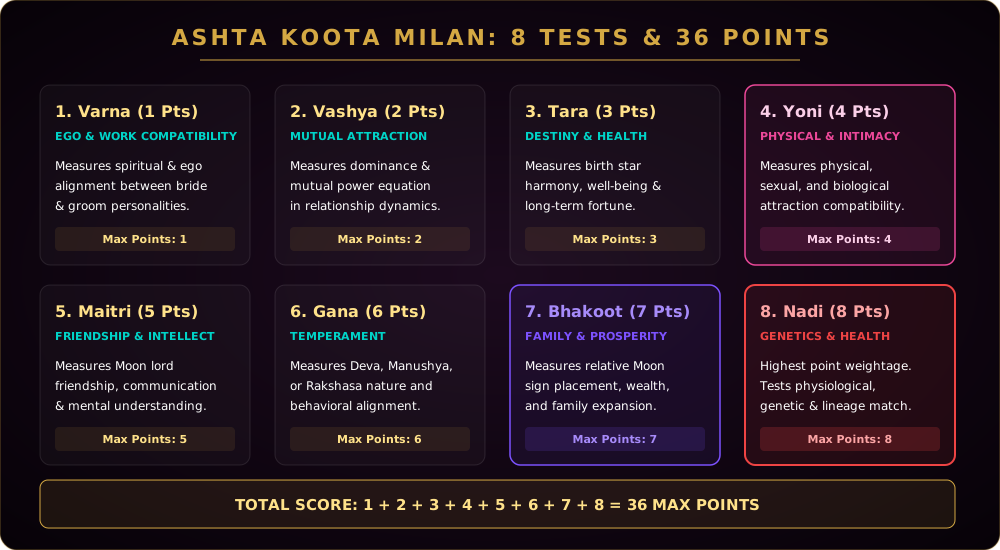
Table of Contents
- What is Kundli Matching (Gun Milan)?
- The Ashta Koota System (8 Tests & 36 Points)
- Guna Milan Score Range & Meaning
- Why Guna Milan Score Alone Is Not 100% Enough
- Understanding Manglik Dosh (Kuja Dosha) & Cancellations
- Nadi Dosh & Bhakoot Dosh Explained
- The Role of Navamsa (D9) Chart in Marriage
- Dasha Compatibility & Marriage Timing
- Practical Checklist Before Saying Yes
- Frequently Asked Questions (FAQs)
What is Kundli Matching (Gun Milan)?
Kundli Matching is the process of comparing the Janam Kundlis (birth charts) of two individuals based on their exact date, time, and place of birth. By analyzing the planetary positions at birth — specifically the Moon sign (Rashi) and Moon Nakshatra (lunar mansion) — Vedic astrologers determine how harmonious the partnership will be across psychological, physical, financial, and spiritual dimensions.
In Northern and Western India, the Ashta Koota system (8 categories) is widely followed, while in Southern India, the Dasha Koota system (10 categories) is utilized. Both systems aim to assess compatibility across the same underlying human and karmic principles.
The Ashta Koota System (8 Tests & 36 Points)
The Ashta Koota method divides compatibility testing into 8 sequential categories (Kootas). Each category carries a specific weightage from 1 point to 8 points, summing to a total score of 36 Gunas.
| Koota Name | Max Points | What It Measures | Life Area Impact |
|---|---|---|---|
| 1. Varna | 1 Point | Ego & Work Temperament | Spiritual & vocational alignment |
| 2. Vashya | 2 Points | Mutual Power & Attraction | Dominance & relationship balance |
| 3. Tara | 3 Points | Birth Star & Destiny | Health, longevity & well-being |
| 4. Yoni | 4 Points | Physical & Intimacy Match | Biological & sexual harmony |
| 5. Graha Maitri | 5 Points | Moon Lord Friendship | Mental, intellectual & emotional bond |
| 6. Gana | 6 Points | Behavioral Temperament | Deva (Divine), Manushya (Human), Rakshasa |
| 7. Bhakoot | 7 Points | Moon Sign Relative Position | Family growth, prosperity & children |
| 8. Nadi | 8 Points | Genetics & Health Lineage | Physiological health & progeny strength |
Guna Milan Score Range & Meaning
When you generate a Kundli matching report, the score is expressed out of 36. Here is how Vedic tradition interprets the score:
- Below 18 Points (Below Average): Generally considered unsuitable for marriage in traditional texts due to potential friction, unless counterbalanced by strong planetary placements in the 7th house and Dasha timelines.
- 18 to 24 Points (Average / Acceptable): Acceptable for marriage. The couple will enjoy good harmony, provided communication and mutual respect are maintained.
- 25 to 32 Points (Very Good): Indicates strong compatibility, mutual understanding, prosperity, and emotional alignment. Highly recommended for marriage.
- 33 to 36 Points (Excellent / Rare): Exceptional karmic bond. The partners naturally complement each other's strengths and weaknesses.
Why Guna Milan Score Alone Is Not 100% Enough
One of the biggest misconceptions in modern astrology is relying solely on the Guna Milan score. A couple with 32/36 Gunas can experience severe marital strain if their 7th house is afflicted, while a couple with 19/36 Gunas can have a blissful 50-year marriage if their Jupiter and Venus are strong!
A complete Vedic horoscope matching must evaluate these additional critical factors:
- 7th House (Kalatra Bhava) Strength: The 7th house governs marriage. The house lord, occupying planets, and aspects on the 7th house determine marital stability.
- 8th House (Mangalya Bhava): Governs longevity of the marital bond and joint finances.
- Venus (Shukra) & Jupiter (Guru): Venus is the natural significator (Karaka) of love, romance, and marriage for all charts. Jupiter represents husband and grace in a woman's chart.
- Navamsa (D9) Divisional Chart: While the Lagna chart (D1) shows initial potential, the Navamsa chart (D9) reveals the inner reality of married life post-30.
- Dasha Timeline Synchronization: Both partners should run favorable, supportive planetary periods (Dashas) after marriage.
Understanding Manglik Dosh (Kuja Dosha) & Cancellations
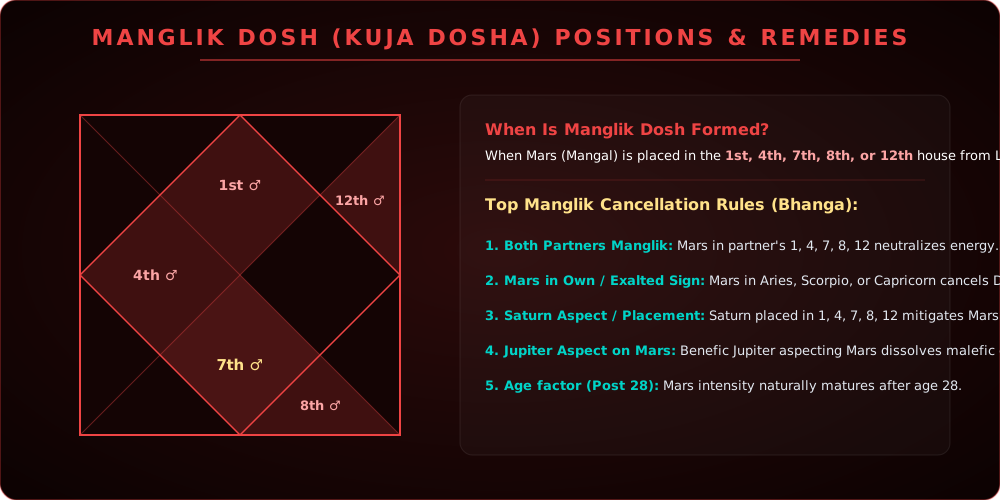
Manglik Dosh is one of the most frequently discussed factors in marriage matching. It occurs when Mars (Mangal) is placed in the 1st, 4th, 7th, 8th, or 12th house from the Lagna, Moon, or Venus.
Why Mars Causes Heat in Marriage
Mars is the planet of energy, passion, ego, assertion, and aggression. When placed in houses connected to self (1st), home peace (4th), spouse (7th), marital bond (8th), or bed pleasures & expenses (12th), Mars can introduce impulsiveness or conflict if unmanaged.
Automatic Manglik Cancellations (Bhanga Rules)
Contrary to popular fear, over 50% of charts containing Mars in these houses have automatic cancellations:
- Both Partners Are Manglik: If both bride and groom have Manglik Dosh, the fiery energies cancel each other out.
- Mars in Own or Exalted Sign: Mars in Aries, Scorpio, or Capricorn does not create harmful Dosh.
- Saturn Placement: If Saturn sits in 1st, 4th, 7th, 8th, or 12th house in the partner's chart, it cools Mars down.
- Jupiter's Aspect: Benefic aspect from Jupiter on Mars neutralizes malefic intensity.
- Age Factor: The aggressive impulse of Mars naturally matures after age 28.
Nadi Dosh & Bhakoot Dosh Explained
Nadi Dosh (8 Points)
Nadi carries the highest weightage (8 points). The three Nadis — Adi (Beginning), Madhya (Middle), and Antya (End) — correspond to Ayurvedic Prakritis (Vata, Pitta, Kapha). If both partners belong to the same Nadi, Nadi Dosh is formed.
Cancellation: If the Moon sign is the same but Nakshatras differ, or if Nakshatras are identical but Nakshatra Padas (quarters) differ, Nadi Dosh is automatically canceled.
Bhakoot Dosh (7 Points)
Bhakoot Dosh occurs when the relative position of the couple's Moon signs forms a 2-12 (Dwirdwadasa), 6-8 (Shadastaka), or 9-5 (Navapanchama) relationship.
Cancellation: If the lords of both Moon signs are mutual friends (e.g., Sun & Jupiter, Mercury & Venus), Bhakoot Dosh is nullified.
The Role of Navamsa (D9) Chart in Marriage
In Vedic astrology, the D1 (Lagna) chart is like the tree trunk, while the D9 (Navamsa) chart is the fruit. An experienced astrologer will never finalize a marriage match without inspecting the Navamsa chart.
- If a planet is weak in D1 but exalted in D9, its results improve dramatically in the second half of life.
- The 7th house of Navamsa reveals the true nature, character, and spiritual devotion of the spouse.
- Venus and Jupiter strength in D9 ensures enduring affection and prosperity.
Dasha Compatibility & Marriage Timing
Even if two charts match well, marriage should occur during favorable planetary periods. Running a Dasha connected to the 7th lord, 1st lord, 5th lord, or 9th lord creates an ideal window for marriage ceremonies and honeymoon harmony. To understand how Dasha timing works in depth, read our guide on Mahadasha and Antardasha explained.
Practical Checklist Before Saying Yes
- Generate a reliable Kundli matching report using accurate birth time.
- Verify that Guna Milan score is 18 or above.
- Check for Manglik, Nadi, or Bhakoot Dosh and confirm cancellation rules.
- Evaluate 7th house and Venus/Jupiter strength in both charts.
- Cross-reference Navamsa (D9) chart for long-term marital bliss.
- Ensure mutual values, communication, respect, and shared life goals align in real life!