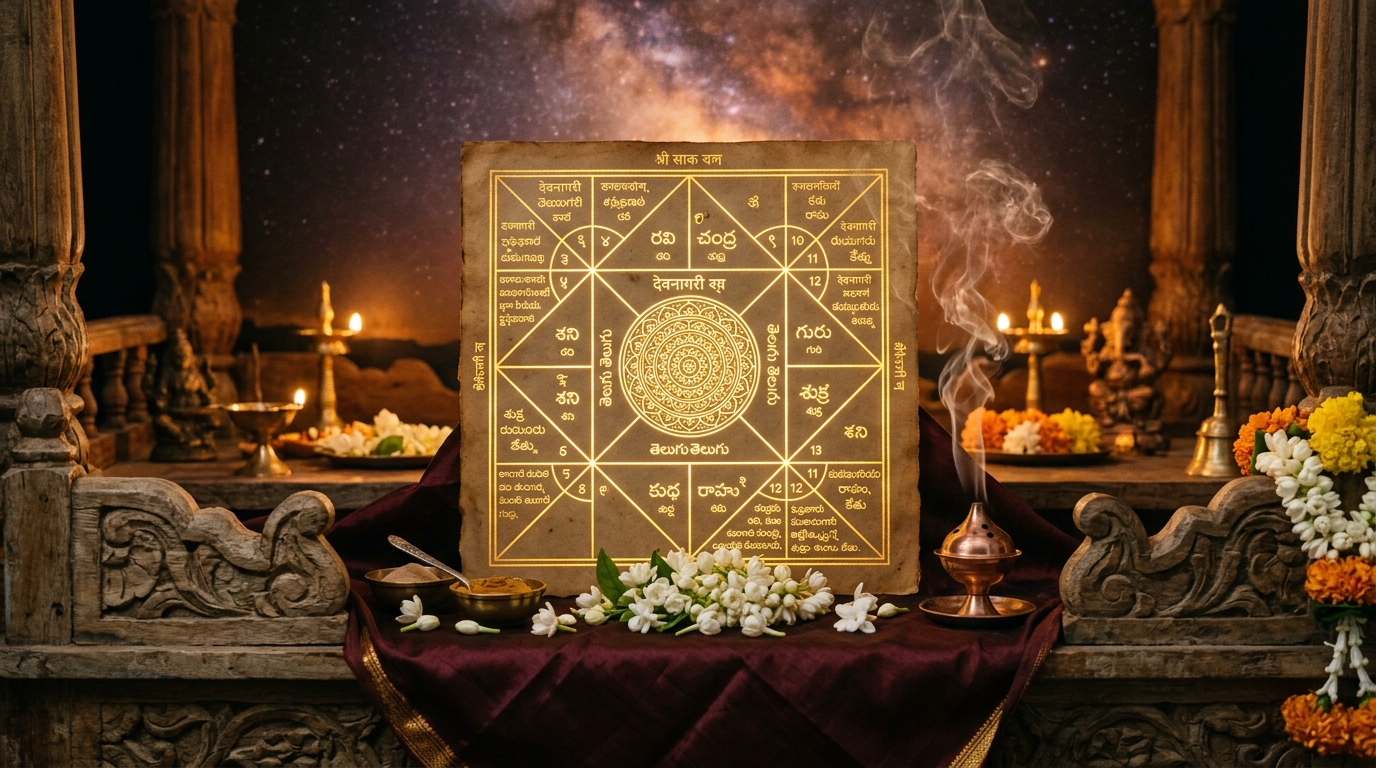
Have you ever wondered what your birth chart says about your personality, career, marriage, or future? In Telugu-speaking families, astrology has been part of everyday conversations for generations. From checking an auspicious date for a new business to matching horoscopes before marriage, many people consult astrology when making important life decisions. This is where Telugu Jathakam becomes relevant. It forms a vital cornerstone of our foundational Telugu astrology guide.
A Jathakam, also known as a birth horoscope, is prepared using a person's date of birth, exact birth time, and birthplace. According to traditional Vedic astrology, these details help determine the positions of planets, the zodiac sign, the birth star, and the twelve houses of a horoscope. Astrologers interpret these elements to provide insights into different areas of life.
Today, people can explore their horoscope through traditional astrologers as well as online astrology platforms. Whether you are curious about your Telugu Rasi, want to understand your Nakshatram, or are looking for information about marriage compatibility, learning the basics can help you understand the terminology used in Telugu astrology.
In this guide, we will explore everything you need to know about Telugu Jathakam, including its meaning, how it is calculated, the importance of Rasi and Nakshatram, marriage matching, career predictions, planetary positions, and how to read your birth chart.
What Is Telugu Jathakam?
Telugu Jathakam is a birth horoscope prepared according to traditional Indian, particularly Vedic, astrological principles. The word "Jathakam" refers to a person's natal chart, which represents the positions of celestial bodies at the time and place of birth.
In Telugu culture, a horoscope is often consulted for understanding traditional astrological interpretations of personality, relationships, career, finances, and other aspects of life. Families may also use it when selecting marriage partners or choosing dates for significant events.
A traditional Jathakam usually includes the Lagna, Rasi, Nakshatram, planetary placements, twelve astrological houses, and various combinations known as Yogas and Doshas. Each element has a specific meaning within the astrological system.
For example, the Lagna represents the zodiac sign rising on the eastern horizon at the time of birth. The Rasi commonly refers to the Moon sign in Vedic astrology, while the Nakshatram identifies the lunar mansion associated with the Moon's position.
These elements are interpreted together rather than independently. An astrologer may examine the relationship between planets, their house placements, and planetary periods before offering a traditional reading.
It is important to understand that astrology is a cultural and spiritual practice, not a scientifically established method for predicting future events. A horoscope can be explored as part of personal reflection or cultural tradition, but it should not replace practical decision-making.
Why Is Telugu Jathakam Important in Telugu Culture?
Astrology has a long history in Telugu-speaking communities across Andhra Pradesh, Telangana, and other parts of India. For many families, a horoscope is more than a chart. It represents a traditional way of understanding important milestones and following family customs.
One of the most common uses of Telugu Jathakam is marriage compatibility. For an in-depth matchmaking analysis, read our complete guide on online jathakam for marriage in telugu or use the Astro27 Marriage Compatibility Tool. Families may compare the horoscopes of two individuals before proceeding with a marriage proposal. They may consider the Moon signs, birth stars, Guna matching, and specific astrological combinations.
Another important use is selecting an auspicious time, traditionally called Muhurtham. People may consult an astrologer before a wedding, housewarming ceremony, business inauguration, naming ceremony, or other significant occasion.
Parents sometimes obtain a birth chart for a newborn child. The chart may be used to identify the child's Rasi and Nakshatram or to help select a traditional name based on the birth star and its associated syllables.
Some people also consult astrologers when thinking about career changes, business opportunities, financial goals, or personal relationships. These readings may offer a framework for reflection, although actual outcomes depend on many practical factors.
The popularity of online astrology has made horoscope information easier to access. People can now enter their birth details into digital tools and view a chart without visiting an astrologer in person.
However, traditional practices differ between families, regions, and astrological schools. Understanding the basics allows you to ask better questions and distinguish between a general horoscope description and an interpretation based on your complete birth chart.
How Is Telugu Jathakam Calculated?
Preparing a birth horoscope involves more than knowing your date of birth. In traditional Vedic astrology, the calculation generally requires three essential details: date of birth, time of birth, and place of birth.
The date establishes the day for which the planetary positions are calculated. The exact time is especially important for determining the Ascendant, or Lagna, because the rising sign changes throughout the day. The birthplace helps establish the local astronomical reference used to calculate the chart.
Using these details, an astrologer or horoscope software calculates the positions of the Sun, Moon, and other planets according to the selected astrological system. Many Vedic astrology calculations use the sidereal zodiac, which differs from the tropical zodiac commonly used in Western astrology.
The resulting chart displays the Lagna, planetary placements, and twelve houses. The Moon's position is used to determine the Rasi and Nakshatram in the traditional system.
Some horoscope calculations also include the Vimshottari Dasha system, which divides life into planetary periods according to a traditional astrological framework. Astrologers may interpret these periods alongside planetary placements when discussing different stages of life.
Accuracy of the birth details matters, especially the birth time. Even a relatively small difference can affect the Ascendant or the placement of planets in houses, depending on the circumstances.
If you do not know your exact birth time, you can still explore certain general astrological details, but a complete birth chart may be less reliable within the system's own assumptions.
When using an online horoscope generator, check whether it requests the correct birthplace, uses the intended time zone, and clearly identifies the astrological settings. Different calculation settings can sometimes produce different results.
Understanding Rasi in Telugu Jathakam
Rasi is one of the most familiar terms in Telugu astrology. In Vedic astrology, the Moon sign is commonly used when discussing a person's Rasi. It is determined by the position of the Moon in the sidereal zodiac at the time of birth.
There are twelve Rasis, each associated with a section of the zodiac. They are Mesha, Vrishabha, Mithuna, Karkataka, Simha, Kanya, Tula, Vrischika, Dhanussu, Makara, Kumbha, and Meena.
Each Rasi has traditional associations with personality traits, emotional tendencies, and general life themes. However, these descriptions are broad interpretations rather than scientifically verified personality assessments.
Mesha Rasi (Aries) is traditionally associated with initiative, courage, independence, and enthusiasm. Vrishabha Rasi (Taurus) is associated with stability, patience, persistence, and a preference for security.
Mithuna Rasi (Gemini) is linked with communication, curiosity, adaptability, and learning. Karkataka Rasi (Cancer) is traditionally connected with emotional sensitivity, family relationships, and nurturing qualities.
Simha Rasi (Leo) is associated with confidence, leadership, creativity, and recognition. Kanya Rasi (Virgo) is linked with organization, attention to detail, analytical thinking, and practical problem-solving.
Tula Rasi (Libra) is associated with balance, cooperation, relationships, and diplomacy. Vrischika Rasi (Scorpio) is traditionally linked with intensity, determination, privacy, and emotional depth.
Dhanussu Rasi (Sagittarius) is associated with exploration, optimism, learning, and philosophical interests. Makara Rasi (Capricorn) is connected with discipline, responsibility, patience, and long-term planning.
Kumbha Rasi (Aquarius) is traditionally associated with independent thinking, social interests, originality, and innovation. Meena Rasi (Pisces) is linked with imagination, compassion, intuition, and creativity.
These descriptions are only introductory. A complete horoscope interpretation considers the entire chart, including the Lagna, planetary positions, aspects, and other astrological factors.
If you want to find your Rasi, you generally need your birth date, time, and place to calculate the Moon's position accurately. Your Sun sign alone may not tell you your Vedic Moon sign.
What Is Nakshatram and Why Does It Matter?
Nakshatram, or birth star, is another essential element of Telugu Jathakam. In the traditional Vedic system, the zodiac is divided into 27 lunar mansions known as Nakshatras. Each Nakshatra occupies a specific portion of the zodiac and is further divided into four Padas.
The Nakshatram is identified using the Moon's position at birth. Because the Moon moves relatively quickly through the zodiac, the birth time can be important when determining the correct star, particularly when the Moon is close to the boundary between two Nakshatras.
The 27 Nakshatras are Ashwini, Bharani, Krittika, Rohini, Mrigashira, Ardra, Punarvasu, Pushya, Ashlesha, Magha, Purva Phalguni, Uttara Phalguni, Hasta, Chitra, Swati, Vishakha, Anuradha, Jyeshtha, Mula, Purva Ashadha, Uttara Ashadha, Shravana, Dhanishta, Shatabhisha, Purva Bhadrapada, Uttara Bhadrapada, Revati, and Abhijit in systems that include the additional Nakshatra.
In the commonly used 27-Nakshatra system, Abhijit is generally treated separately rather than counted as one of the standard 27 lunar mansions.
Each Nakshatra has traditional symbolism and astrological associations. For instance, Rohini is commonly associated with growth and creativity, while Hasta is connected with skill and craftsmanship. Interpretations vary depending on the astrological tradition.
Nakshatram is also important in naming customs. Some Telugu families select a baby's name using syllables associated with the birth star and Pada. This is a cultural naming practice, and families may follow different conventions.
In marriage matching, Nakshatram can be used to assess traditional compatibility factors. Astrologers may also consider the Moon sign, planetary placements, and other elements before reaching an interpretation.
Knowing your birth star can therefore help you understand many terms commonly found in a Telugu horoscope report.
Telugu Jathakam for Marriage Compatibility
Marriage compatibility is one of the main reasons people search for Telugu Jathakam online. In many Telugu families, horoscope matching is traditionally performed before a marriage is finalized.
The purpose of this practice is to compare the birth charts of two individuals according to established astrological rules. Families may consult an astrologer to understand how the charts are interpreted in relation to relationships, communication, family life, and long-term compatibility.
One commonly used method is Guna Milan, although the specific matching system and criteria can vary across regional traditions. Telugu astrologers may also use approaches associated with South Indian horoscope matching, including Nakshatra-based Porutham or Koota considerations.
During traditional matching, the astrologer may examine the Moon signs and birth stars of both individuals. Additional factors can include the seventh house, the condition of Venus and Jupiter in relevant interpretations, and planetary periods.
Some families also ask about Manglik Dosha, known in some South Indian traditions as Kuja Dosha. The interpretation generally involves the placement of Mars in specified houses, although the rules, exceptions, and significance assigned to it differ between astrological schools.
A common misunderstanding is that a single mismatch automatically means a marriage cannot succeed. In practice, traditional astrologers may consider multiple factors and exceptions rather than relying on one result alone.
More importantly, a successful relationship depends on real-world compatibility. Shared values, emotional maturity, communication, mutual respect, financial expectations, and the ability to resolve disagreements are all important considerations.
A horoscope should never be used as the sole reason to accept or reject a marriage proposal. If astrology is meaningful to your family, it can be considered alongside open conversations about life goals, personal boundaries, and expectations.
When exploring Telugu Jathakam for marriage, make sure both individuals' birth details are entered correctly. Incorrect birth times or locations can change the resulting charts and potentially affect the interpretation.
What Is Kuja Dosha in Telugu Jathakam?
Kuja Dosha, also known as Manglik Dosha in some astrological traditions, is a concept associated with the placement of Mars in a birth chart.
According to certain Vedic astrology interpretations, Mars occupying particular houses may be considered relevant to marriage and relationships. The houses commonly discussed include the first, second, fourth, seventh, eighth, and twelfth, although the precise rules vary between traditions.
Astrologers may assess the placement of Mars from the Lagna, Moon, or Venus, depending on the system being followed. They may also consider the sign occupied by Mars, aspects from other planets, and traditional cancellation rules.
This is why a simple online label stating that someone has Kuja Dosha may not represent the complete traditional interpretation. Different calculators may use different settings, and an astrologer may consider additional chart details.
Some families request a comparison of both horoscopes when this factor appears in either chart. However, there is no scientific evidence establishing that Kuja Dosha determines whether a marriage will succeed or fail.
A person's relationship outcomes are influenced by many factors, including communication, emotional compatibility, shared responsibilities, and the way partners handle challenges.
If you are concerned about a Kuja Dosha result, avoid making major relationship decisions based on fear. You can discuss the cultural significance with a knowledgeable astrologer while also considering the relationship itself and the wishes of both individuals.
Telugu Jathakam and Career Predictions
Many people explore Telugu Jathakam because they want to understand their professional direction. Questions about employment, business, promotions, career changes, and financial stability are common topics in traditional horoscope readings.
In Vedic astrology, the tenth house is commonly associated with profession, public reputation, responsibilities, and career-related activities. The sixth house is often discussed in connection with service, daily work, and competition, while the second and eleventh houses may be considered in traditional interpretations of income and gains.
Astrologers may examine the condition of the tenth house, its ruling planet, the placement of Saturn, and other planetary combinations when preparing a career reading. The Dasha system may also be considered when discussing the timing of professional developments.
Some interpretations associate Mercury with communication and analytical work, Jupiter with teaching and knowledge, Saturn with discipline and responsibility, and Mars with action-oriented activities. These are traditional symbolic associations rather than proven indicators of occupational suitability.
For example, a person interested in digital marketing may benefit from assessing their communication skills, creativity, analytical ability, and knowledge of advertising platforms. Someone interested in teaching may focus on subject expertise, presentation skills, and classroom management.
These practical factors are more useful for choosing a profession than relying on a horoscope alone. Career growth depends on education, experience, market demand, networking, consistent effort, and the ability to adapt.
You can explore a career reading as part of personal reflection if astrology is important to you. However, use practical information such as salary expectations, employment opportunities, training requirements, and personal interests when making professional decisions.
Can Telugu Jathakam Predict Marriage Timing?
Marriage timing is another popular topic in horoscope consultations. Traditional astrologers may examine planetary periods, the seventh house, its ruling planet, and certain planetary transits when discussing periods that are considered favorable for marriage.
Some astrologers also study Venus, Jupiter, and the Navamsa chart, known as D9, depending on the individual's horoscope and the interpretive tradition being followed.
These calculations are used within astrology to suggest possible periods for relationship developments. They cannot reliably establish the exact date when someone will marry, whether a proposal will be accepted, or how a relationship will develop.
Marriage depends on personal choices, circumstances, social connections, readiness, and mutual agreement. A horoscope cannot replace these real-world considerations.
If you are exploring marriage timing through Telugu Jathakam, treat any prediction as a traditional interpretation rather than a guarantee. There is no need to feel pressured to marry by a particular age because of an astrological prediction.
A healthy relationship built on trust, respect, shared expectations, and informed consent is more important than meeting a predicted timeline.
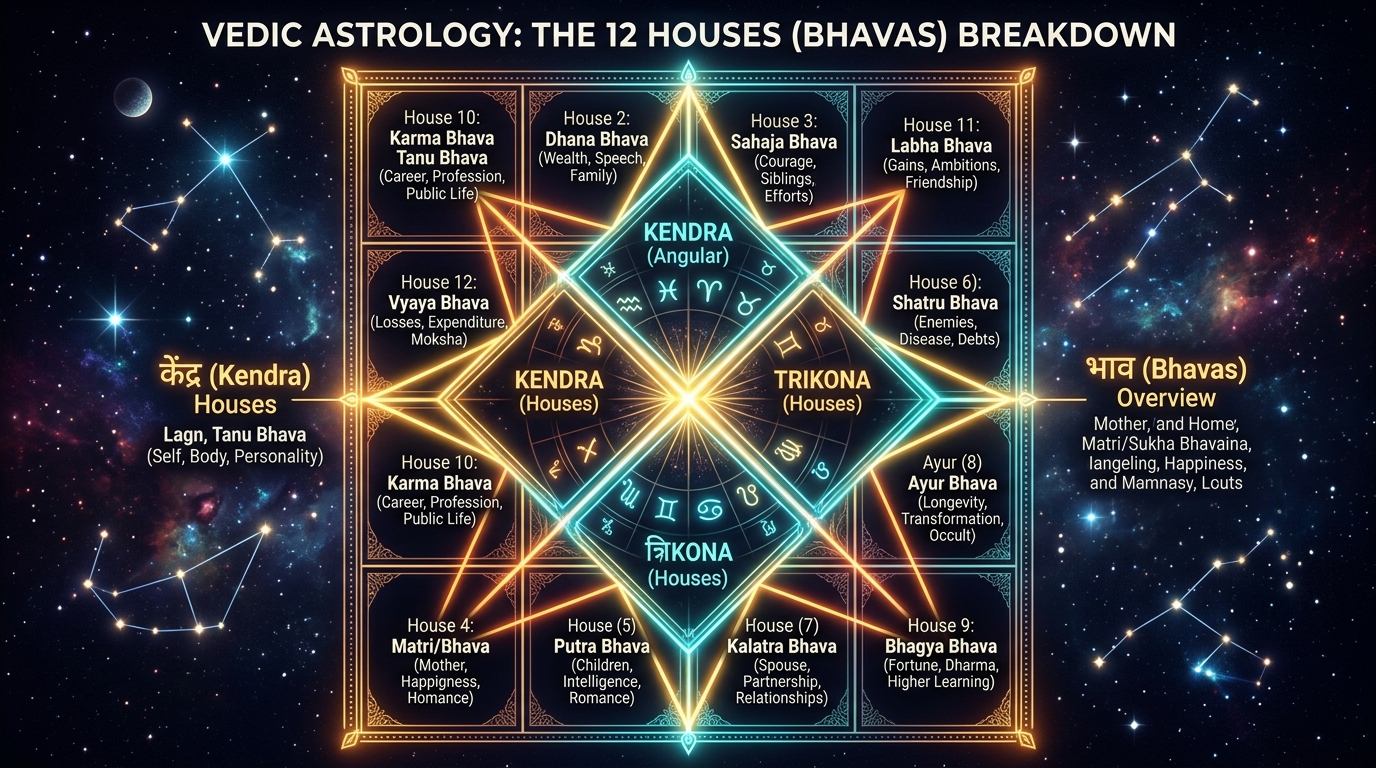
Understanding the Twelve Houses in Telugu Jathakam
A traditional Vedic birth chart contains twelve houses, each associated with different themes. The interpretation of a house depends on its sign, ruling planet, planetary occupants, aspects, and the broader chart.
The first house, or Lagna Bhava, is associated with the self, physical appearance, temperament, and personal approach to life. The second house is traditionally connected with family, speech, accumulated resources, and food habits.
The third house relates to communication, initiative, courage, siblings, and personal effort. The fourth house is associated with home, family comfort, property, education in some interpretations, and emotional foundations.
The fifth house is traditionally connected with creativity, education, children, intelligence, and speculative activities. The sixth house is associated with work routines, service, competition, debts, and health-related matters within the astrological framework.
The seventh house represents partnerships, marriage, business relationships, and one-to-one interactions. The eighth house is linked with transformation, shared resources, inheritance, uncertainty, and hidden matters.
The ninth house is associated with higher learning, philosophy, beliefs, long-distance journeys, and fortune in traditional interpretations. The tenth house relates to career, responsibility, public reputation, and professional standing.
The eleventh house is associated with income, networks, friendships, aspirations, and gains. The twelfth house is traditionally linked with expenses, sleep, retreat, foreign connections, and spiritual themes.
These descriptions provide a basic introduction to house meanings. They should not be treated as independent predictions because astrologers generally interpret houses in relation to the rest of the horoscope.
The Importance of Planets in Telugu Jathakam
Planets play a central role in traditional Vedic astrology. The system commonly considers the nine Grahas: the Sun, Moon, Mars, Mercury, Jupiter, Venus, Saturn, Rahu, and Ketu.
Rahu and Ketu are lunar nodes rather than physical planets. Nevertheless, they are treated as important astrological factors in the traditional system.
The Sun is associated with authority, confidence, vitality, and leadership. The Moon is connected with emotions, mental tendencies, comfort, and habits.
Mars represents energy, action, courage, and assertiveness in traditional interpretations. Mercury is associated with communication, reasoning, business, and learning.
Jupiter is commonly linked with knowledge, teaching, growth, wisdom, and prosperity. Venus is associated with relationships, beauty, enjoyment, art, and material comforts.
Saturn represents discipline, responsibility, patience, limitations, and long-term effort. Rahu is often associated with ambition, unconventional interests, material desires, and sudden changes, while Ketu is linked with detachment, introspection, and spiritual themes.
The influence assigned to a planet depends on its position and relationship with other chart elements. For instance, the same planet may be interpreted differently depending on the house it occupies and the sign in which it is placed.
These meanings belong to the traditional astrological framework. They do not demonstrate that planets directly determine a person's personality, health, financial status, or future.
What Are Dasha and Bhukti in Telugu Jathakam?
If you have viewed a detailed horoscope report, you may have come across the terms Dasha and Bhukti, also called Antardasha.
In Vedic astrology, Dasha refers to a planetary period. One widely used system is Vimshottari Dasha, which assigns different periods to nine planetary rulers over a traditional 120-year cycle.
The starting point of the sequence is calculated using the Moon's Nakshatram at birth. The remaining portion of the initial planetary period depends on the Moon's position within that Nakshatra.
Bhukti, or Antardasha, refers to a subperiod within a major planetary period. Astrologers interpret the major and subperiod rulers alongside the birth chart and planetary transits.
For example, a horoscope report may display a Jupiter Mahadasha followed by a Saturn Antardasha. An astrologer may discuss these periods in relation to career, education, family, or other themes based on traditional rules.
Different periods are assigned symbolic meanings, but they do not provide a scientifically reliable way to predict specific life events. A planetary period should not be treated as proof that a particular outcome will happen.
If you are reading your own horoscope, understanding these terms can help you follow an astrologer's explanation without assuming that the predictions are certain.
How to Read a Telugu Jathakam Chart
A Telugu horoscope may look complicated at first, especially if you are unfamiliar with the symbols, abbreviations, and house arrangements. However, learning a few basic terms can make the chart easier to understand.
Begin by identifying the Lagna. This is the Ascendant determined from the birth details and is commonly used as the starting point for interpreting the twelve houses.
Next, identify the Moon sign and Nakshatram. These details are frequently displayed near the top of an online horoscope report.
After that, look at the planetary placements. A chart may use abbreviations for the Sun, Moon, Mars, Mercury, Jupiter, Venus, Saturn, Rahu, and Ketu. The sign and house associated with each planet are important in traditional interpretation.
Many Vedic charts are presented in North Indian or South Indian formats. In the South Indian chart style, signs are usually displayed in fixed positions, while the Ascendant is marked to indicate the first house. North Indian charts commonly use a different arrangement in which the houses occupy fixed positions.
The chart may also contain separate sections for the Rasi chart and Navamsa chart. The Rasi chart represents the primary birth chart, while the Navamsa is a divisional chart traditionally used for more detailed interpretation, including marriage-related themes.
You may also find tables listing planetary degrees, Nakshatras, Padas, and Dasha periods. These details can help an astrologer make a more specific reading.
If you are a beginner, do not try to predict your entire future from one planetary placement. Start with the basic chart elements and understand how traditional astrologers combine them.
Telugu Jathakam Online: How to Check Your Horoscope
Checking your horoscope online is relatively straightforward. Many astrology websites provide birth chart calculators that generate a report after you enter your personal birth details.
First, find a horoscope service that clearly explains its calculation method and the information it provides. Look for a tool that supports Vedic astrology and the chart format you prefer.
Enter your date of birth accurately. Then provide your birth time, including AM or PM where applicable. Finally, enter your birthplace, such as your town or city, and check that the location is correct.
Once the details are submitted, the calculator may display your Lagna, Rasi, Nakshatram, planetary positions, and birth chart. Some services also offer marriage compatibility, Dasha calculations, and detailed horoscope interpretations.
Before relying on the results, check whether the website uses the correct time zone and whether you have entered the exact birth location. Differences in settings can affect certain calculations.
Be careful when sharing personal information online. A basic birth chart may not require your phone number, financial information, identity documents, or unrelated personal details. Read the site's privacy policy before submitting information.
Free horoscope calculators can be useful for understanding basic terminology, while a detailed consultation may offer a more extensive traditional interpretation. Neither should be considered a scientifically proven prediction of future events.
Telugu Jathakam for Naming a Newborn Baby
In many Telugu households, a newborn baby's Jathakam is prepared soon after birth. One reason is to identify the baby's Rasi and Nakshatram and follow traditional naming customs.
In some families, the Nakshatra Pada is used to identify an auspicious starting syllable for the child's name. Parents may then choose a name that fits the suggested sound while also considering its meaning, pronunciation, and cultural significance.
For example, families may prefer names that reflect positive qualities, family traditions, religious associations, or modern naming preferences. The final decision often combines astrological customs with personal taste.
It is worth remembering that naming conventions vary between families and astrological traditions. A name does not need to be selected solely on the basis of a birth star, and there is no scientific evidence that a particular starting syllable determines a child's future.
If you want to follow this tradition, confirm the birth time and location before generating the horoscope. Then discuss the suggested syllables with family members and choose a name that feels meaningful to you.
Telugu Jathakam and Financial Predictions
Financial questions are another reason people seek astrological guidance. They may want to understand traditional interpretations related to income, savings, business, property, or financial opportunities.
In Vedic astrology, the second house is commonly associated with accumulated wealth and family resources. The eleventh house is associated with income and gains, while the tenth house is linked with profession and public standing.
Astrologers may examine the relationships between these houses and their ruling planets. Some also consider Jupiter, Venus, planetary periods, and other combinations when discussing finances.
However, a horoscope cannot reliably tell you whether a particular investment will succeed, whether a stock price will rise, or when you will become wealthy. Financial outcomes depend on income, spending, market conditions, risk, and the quality of financial decisions.
If you enjoy exploring astrology, you can treat a financial reading as a cultural or personal reflection exercise. For actual money decisions, use budgeting, emergency savings, diversification, risk assessment, and reliable financial information.
Avoid borrowing money, making speculative investments, or taking on significant financial risk because an astrologer predicts a favorable period.
Common Mistakes to Avoid When Checking Telugu Jathakam
One common mistake is entering an incorrect birth time. Because the Lagna and house placements depend on the time of birth, an inaccurate entry may produce a chart that differs from the one intended.
Another mistake is assuming that the Rasi and Sun sign are always the same. In Vedic astrology, Rasi commonly refers to the Moon sign, whereas popular Western horoscope descriptions often emphasize the Sun sign.
People also sometimes focus too much on one Dosha or planetary placement. A single label does not explain an entire birth chart, even within traditional astrology.
Another issue is comparing horoscope reports generated using different calculation settings without understanding the differences. Ayanamsha, chart format, time-zone handling, and other settings may influence the results.
Some people also treat general horoscope descriptions as guaranteed predictions. It is better to recognize that traditional readings are interpretations, not established facts about future events.
Finally, avoid sharing sensitive personal details with unfamiliar websites or making important life decisions under pressure. An astrology service should explain its process clearly and respect your privacy.
Frequently Asked Questions About Telugu Jathakam
What details are required to check Telugu Jathakam?
You generally need your date of birth, exact birth time, and birthplace. These details help calculate the Lagna, Rasi, Nakshatram, and planetary positions used in a traditional Vedic horoscope.
Can I check Telugu Jathakam for free?
Yes. Several online horoscope calculators offer free birth charts and basic astrological details. The information available depends on the service. Check its calculation settings and privacy policy before entering your details.
What is the difference between Rasi and Nakshatram?
Rasi refers to a zodiac sign, commonly the Moon sign in Vedic astrology. Nakshatram refers to the lunar mansion occupied by the Moon. Both are used in traditional horoscope interpretations, but they represent different divisions of the zodiac.
Is the exact birth time necessary for Telugu Jathakam?
An exact birth time is particularly useful for determining the Lagna and house placements. Some basic astrological details may still be available without it, but certain parts of a complete chart may be uncertain.
How is Telugu Jathakam used for marriage matching?
Traditional marriage matching may compare the Rasi, Nakshatram, compatibility factors, and other planetary placements of two individuals. Different families and astrological traditions follow different methods. Horoscope matching should not replace conversations about values, consent, expectations, and relationship compatibility.
What is Kuja Dosha in Telugu astrology?
Kuja Dosha is a traditional astrological concept associated with Mars occupying specified houses in a birth chart. Its interpretation and cancellation rules vary. There is no scientific evidence that it determines the success or failure of a marriage.
Can Telugu Jathakam predict my career?
Traditional astrologers interpret houses and planetary positions to discuss career-related themes. However, astrology has not been established as a reliable method for predicting professional success. Skills, education, experience, and opportunities are practical factors to consider when planning your career.
Can I find my baby's name using Telugu Jathakam?
Some Telugu families use the birth star and Pada to identify traditional starting syllables for a baby's name. You can consider these suggestions alongside the name's meaning, pronunciation, and your family's preferences.
Is online Telugu Jathakam accurate?
The accuracy of the astronomical calculations depends on the quality of the birth details, time-zone handling, and calculation settings. The interpretation of those calculations belongs to astrology, which is not a scientifically established method of predicting life outcomes.
What is the difference between a Rasi chart and a Navamsa chart?
The Rasi chart is the primary birth chart in Vedic astrology. The Navamsa chart is a divisional chart traditionally used for additional interpretation, including marriage-related themes. Both are interpreted within the broader astrological framework.
What are Dasha and Bhukti?
Dasha refers to a planetary period in a traditional timing system, while Bhukti or Antardasha refers to a subperiod within it. Astrologers interpret these periods alongside the birth chart, but they do not guarantee that specific events will occur.
Can Telugu Jathakam tell me when I will get married?
Some astrologers use planetary periods, houses, and transits to suggest traditionally favorable marriage periods. These interpretations cannot reliably establish an exact marriage date. Personal readiness, mutual agreement, and real-world circumstances remain important.
Conclusion: Understand Your Telugu Jathakam With Confidence
Telugu Jathakam remains an important part of traditional astrology for many Telugu-speaking families. From identifying a person's Rasi and Nakshatram to exploring marriage compatibility and traditional career interpretations, a birth horoscope brings together several concepts that have been passed down through generations.
Understanding the basics makes it easier to read a horoscope report, recognize the twelve houses, and learn the meanings of planetary periods and astrological terminology. It can also help you approach online astrology services with better awareness of their calculation methods and limitations.
If you want to explore your own horoscope, begin with accurate birth details and a reliable chart calculator. Take time to understand the difference between the Lagna, Rasi, Nakshatram, and planetary placements instead of relying on a single prediction.
Most importantly, approach astrology with a balanced perspective. You can appreciate its cultural significance and use it as a way to reflect on your questions while making important decisions based on practical information, personal values, and informed judgment.
Whether you are checking your birth star, learning about traditional marriage matching, or simply curious about Vedic astrology, understanding Telugu Jathakam is a useful starting point for exploring this long-standing tradition.
Calculate Your Complete Janma Jathakam Online
Get accurate calculations for your Lagna, Rasi, Nakshatram, and Vimshottari Dasha periods using authentic Vedic ephemeris algorithms.